Visitors to the Nasher
Sculpture Center
this fall will be able to see the newest addition to the museum’s
collection: Fountainhead, a beautifully produced oversized
artists’ book. A gift of the Art Foundation, Fountainhead was
inspired by one of the great conceptual gestures of modern art. In 1917,
Marcel Duchamp, using the pseudonym R. Mutt, submitted a porcelain urinal as a
work of art to an exhibition supposedly open to all. Its rejection
prompted Duchamp to issue a statement that laid the foundation not only for
Conceptual Art, but also for art that embraces everyday objects:
“Whether Mr. Mutt with his own hands made the
fountain or not has no importance. He CHOSE it. He took an ordinary article of
life, placed it so that its useful significance disappeared under a new title
and point of view – created a new thought for that object.”
In the ensuing scandal, Fountain disappeared, its
existence documented only by photographs (until being replicated by Duchamp on
several occasions, many years later). The Art Foundation’s founding members –
Joshua Goode, Ryder Richards, Lucia Arbery Simek and Andrew Douglas Underwood –
had the inspired idea to return to this “fountainhead” of contemporary art by
soliciting the alteration of various photographs of Fountain, by a
number of local and international artists. Their imaginative efforts render an
iconic image of the past a newly vibrant part of the present.
Artists include:
Frances Bagley (Dallas), Jesse Morgan Barnett (Dallas), Laetitia Benat (Paris,
FR), Richie Budd (Fort Worth), Rebecca Carter (Dallas), Steve Cruz (Dallas),
Matt Cusick (Dallas), Laura Doughtie (Dallas), Erika Duque (Fort Worth), Celia
Eberle (Dallas), Cassandra Emswiler (Dallas), Teresa Gomez-Martorell (Barcelona,
SP), Brenton Good (Harris, Pennsylvania), Sara Hignite (Dallas), Kelly Lynn
Jones (San Francisco, CA), Gerald Lopez (Corpus Christi, TX), Stephanie
Madewell (Brooklyn, NY), Sam Matineau (Brooklyn, NY), Lindsay McCulloch
(Washington, DC), Ruben Nieto (Dallas), Tom Orr (Dallas), Sara Pringle
(Brooklyn, NY), Teresa Rafidi (Dallas), Adam Raymont (Berlin), Enrico Riley
(Vermont), Gregory Ruppe (Fort Worth), Gretchen Schermerhorn (Washington, DC),Shawn Smith (Austin, TX), Ian F. Thomas (Slippery Rock, PA), Karen Weiner
(Dallas), Jonathan Whitfill (Lubbock, TX), and Zero (location unknown).
The pages of Fountainhead will be turned
periodically during the run of its exhibition.
WASHINGTON The Smithsonian's Renwick Gallery in Washington is
exploring the future of artistic crafts with a new exhibit featuring
works from 40 artists from across the country, including one from
Austin, who are younger than 40 and who represent something new.
The
exhibition, "40 under 40: Craft Futures," opened July 20 with artworks
all created since Sept. 11, 2001. Their work spanning ceramics,
metalwork, fashion, industrial design and other fields, is meant to
reflect the changed world since 9/11.
Austinite Shawn Smith is the only Texan in the show.
"I
like to take non-things, like digital images, and translate them back
into things," Smith told the American-Statesman in 2010.
The
museum says the 40 artists in the show share philosophies of emphasizing
sustainability, valuing hand-made things and considering what it means
to live in a state of persistent unease.
Curator Nicholas Bell reviewed work by 2,000 artists to find work representing new directions.
Bell says the artists represent the most engaging work of their generation.
As a kid, Shawn Smith spent hours playing
the Atari game Pitfall, in which players tromp
though a forested gauntlet of rolling logs,
quicksand, rattlesnakes, and fire. “I’d never been camping, so I
thought that’s what it was: wrestling crocodiles living in pixelated
lakes,
jumping over scorpions,” Smith says. “The whole idea was to avoid
nature and win some gold coins.”
That
8-bit-centric worldview still holds true for the Austin artist, who is
working on a series called Re-things:
three-dimensional pixelated sculptures of animals and other outdoorsy
objects, which he builds from wooden cubes and square dowels.
“The
’80s were a transition time—videogames were just coming into the home,”
Smith says. “They became an escape for me.” To construct his
pieces, Smith zooms in on a photograph and then creates a drawing of it
on graph paper. He uses that as a map to build digital-looking mountain
goats, campfires, even a marlin called Tevatron
(above). The
big-game fish was put through what the sculptor calls “my own particle
accelerator” to create a disintegrating effect; it’s an exercise in
removing data without compromising our ability to recognize an image.
Smith
will be part of the Smithsonian’s upcoming show 40 Under 40:
Craft Futures, which opens in July. For the exhibition, he’s
creating a new campfire
piece. Maybe one of these days he’ll finally get around to going
camping.
Smithsonian
American Art Museum Announces Artists Selected for Exhibition
“40 under 40: Craft Futures” Opening in 2012 at its Renwick Gallery
Shawn
Smith's Between
1 and 0 (2011). Photo by Teresa Rafidi.
The Smithsonian American Art Museum has
selected the 40 artists who will be featured in its upcoming exhibition “40 under 40: Craft
Futures” that will be on view at its Renwick Gallery from July 20, 2012, through Feb. 3, 2013.
Nicholas R. Bell, curator at the museum’s Renwick Gallery, selected the artists and is organizing the
exhibition.
All of the
artists in “40 under 40” were born since 1972, the year the museum’s
contemporary craft and
decorative arts program was established at its, branch museum, the
Renwick Gallery. The exhibition
investigates evolving notions of craft within traditional media such as
ceramics and metalwork,
as well as in fields as varied as sculpture, industrial design,
installation art, fashion design, sustainable
manufacturing and mathematics. The range of disciplines represented
illustrates new avenues
for the handmade in contemporary culture.
“40 under
40: Craft Futures” is presented in honor of the 40th anniversary of the
Renwick Gallery. The
museum intends to acquire artworks by every artist in the exhibition
for the permanent collection,
to mark the anniversary. The exhibition will tour nationally after it
closes in Washington, D.C.“When the
Renwick Gallery opened in 1972, it introduced a new generation of
artists to the American
public,” said Elizabeth Broun, The Margaret and Terry Stent Director of
the Smithsonian American
Art Museum. “I am excited that we are poised now to introduce to the
museum’s community
these 40 young artists who will inspire a new generation of craft
enthusiasts and collectors.”
The 40
artists selected to be featured in the exhibition are: Vivian Beer,
Melanie Bilenker, Jeffrey
Clancy, Dave Cole, Cristina Córdova, Gabriel Craig, Jennifer Crupi,
Erik Demaine, Joshua DeMonte,
Brian Dettmer, Nick Dong, Joseph Foster Ellis, Jeff Garner, Theaster
Gates, Sabrina Gschwandtner,
Jenny Hart, Sergey Jivetin, Lauren Kalman, Lara Knutson, Stephanie
Liner, Marc Maiorana,
Sebastian Martorana, Christy Matson, Cat Mazza, Daniel Michalik, Matt
Moulthrop, Christy
Oates, Olek, Andy Paiko, Mia Pearlman, Lacey Jane Roberts, Laurel Roth,Shawn
Smith, JenStark,
Matthew Szösz, Uhuru (Jason Horvath and William Hilgendorf), Jamin
Uticone, Anna Von Mertens,
Stacey Lee Webber and Bohyun Yoon.
“What
ultimately unifies these artists, who originate from every region of
the United States and five
countries, are commonly held philosophies of craft’s role as a positive
force in contemporary life,”
said Bell.
Information
about each artist is available through links on the exhibition page on
the museum’s website.
The public can join the conversation about the exhibition on Twitter by
following @americanart
and using #Renwick40.
Publication
A catalog is forthcoming. It
will be written by Bell with contributions by Bernard L. Herman, the
George B. Tindall Professor of American studies at the University of
North Carolina, Chapel Hill; Michael Prokopow, associate professor,
faculty of liberal studies at Ontario College of Art and Design; and
Julia Bryan-Wilson, associate professor of art history at the
University of California, Irvine.
Credit
Fleur Bresler, the Ryna and Melvin Cohen
Family Foundation Endowment and the James Renwick Alliance generously support “40
under 40: Craft Futures.”
About the Renwick Gallery of the Smithsonian
American Art Museum
The Smithsonian American Art Museum
celebrates the vision and creativity of Americans with works of art in all media spanning more than
three centuries. The museum’s branch for craft and decorative arts, the Renwick Gallery, is
located on Pennsylvania Avenue at 17th Street N.W. It is opendaily from
10 a.m. to 5:30 p.m., except Dec. 25. Admission is free. Metrorail
station: Farragut North (Red
line) and Farragut West (Blue and Orange lines). Follow the museum on
Twitter, Facebook, Flickr,
ArtBabble, iTunes and YouTube. Museum information (recorded): (202)
633-7970. Smithsonian
Information: (202) 633-1000; (202) 633-5285 (TTY). Website: americanart.si.edu
The brief lifespan of video games has been one of extraordinarily rapid
advancement, particularly in terms of graphics.
If a comparison can be made
to the art world then computer games have travelled from crude cave
drawings, through the Renaissance, landing
somewhere around Realism in a relative blink of an eye since they first
appeared in the late 50s.
These wooden sculptures by artist
Shawn Smith pay homage to a period in the mid 80s when
computer graphics actually
had more in common with a kind of Pointillism - if you were to use a
square paint brush; the pixilated fires, monsters and animals gaming
veterans will associate with early consoles like the ZX Spectrum or
Commodore 64.
"Video games are an
inspiration," Smith admits, "But so is the fact I really don't know
much about the natural world."
"What I do know, I really
only know through a screen. I grew up in
Dallas, Texas. It is a big city without that many places to go camping.
I have never seen a real campfire. I have never spent the night under
the stars in a sleeping bag.
"These sculptures are about
how much of the world is understood
through some type of coded digital translation/re-translation rather
than direct experience.
Albino Alligator,
one of Smith's pixel sculptures
"What happens to an object or experience when information is lost,
colours are distilled?"
40-year-old Smith holds a
masters degree in sculpture from California College of the Arts in San
Francisco, and has been widely exhibited
around America. This year, his work will be shown as part of a large
show at the Smithsonian American Art Museum's Renwick Gallery.
"I think the work has engaged
people in and outside of the art world. I get very interesting
responses from people who work in the
technology, computers, video games. I think the subject matter has a
universal appeal that a lot of people can relate to" he says.
After 7 years exhibiting in
his own country, Smith now plans to try expand elsewhere.
"I am about to have my first
solo show of this work in Europe. I am
hoping to have more of a presence in Europe, Asia, the world!"
Perhaps, somewhere along the
way, he'll get a chance to camp out under the stars.
The Gibson Company Lofts/824
Exposition Ave. / #6/ Dallas
Opening reception Saturday,
April
14, 6-9 pm
(Dallas, TX, March 22, 2012)
-- For its inaugural curated
exhibition, Fountainhead, The Art
Foundation has solicited the alteration of various photographic
iterations of Marcel
Duchamp’s readymade, Fountain, by a
number of local and international artists. The altered images have been
compiled
in an outsized book that will be exhibited during the weekend of the
Dallas Art
Fair, April 14-15, alongside a small exhibition of art objects that
explore
themes of authorship, receptivity, deception and manipulation.
Referencing the prankster
quality of Duchamp’s decimation of
the existing art structures of his time, Fountainhead
parrots the language of the traditional exhibition structure while
reveling in
the paradoxes and latitudes allowed in our current poly-post-ism of
art. Flexing
ideas of attribution, the works presented in Fountainhead
alternately specify and misconstrue authorship, as a
means of bothering the leveled readings of the objects and actions
presented in
the exhibition.
Contributing artists featured
in the Fountainhead book include: Frances Bagley
(Dallas), Jesse Morgan
Barnett (Dallas),Laetitia Benat (Paris, FR), Rebecca Carter (Dallas),
Piotr
Chiszinski (Ithaca, NY), Steve Cruz (Dallas), Matt Cusick (Dallas),
Laura
Doughtie (Dallas), Erika Duque (Fort Worth), Celia
Eberle (Dallas), Cassandra Emswiler
(Dallas), Teresa Gomez-Martorell (Barcelona, SP), Brenton Good (Harris,
Pennsylvania),
Sara Hignite (Dallas), Kelly Lynn Jones (San Francisco, CA), Gerald
Lopez
(Corpus Christi, TX), Stephanie Madewell (Brooklyn, NY), Sam Matineau
(Brooklyn, NY), Lindsay McCulloch (Washington, DC), Ruben Nieto
(Dallas), Tom
Orr (Dallas), Sara Pringle (Brooklyn, NY), Teresa Rafidi (Dallas), Adam
Raymont
(Berlin), Enrico Riley (Vermont),
Gregory
Ruppe (Fort Worth), Gretchen Schermerhorn (Washington, DC), Shawn
Smith
(Austin, TX), Ian F. Thomas (Slippery Rock, PA), Karen
Weiner (Dallas), Jonathan Whitfill
(Lubbock, TX), and Zero
(location unknown).
Exhibited art objects by
Jesse Morgan Barnett (Dallas), Brian
Jobe (Knoxville, TN), Kelly Lynn Jones (San Francisco, CA,) Gerald
Lopez
(Corpus Christi,) and Carla Nicolás (Zaragoza, Spain).
Exhibition hours:
Saturday, April 14, 12:00 pm – 9 pm; Sunday, April 15, 1-4 pm.
Washington Design Center pairs
interior designers and crafters for dream collaboration
March 22, 2012
by Susan Reimer
A modern lounge designed by
Jeff Akseizer and Jamie Brown inspired by Shawn Smith's sculpture, Between
One and Zero (Morgan Howarth, Baltimore Sun)
WASHINGTON — — It is a match
made in heaven, or at least in that part of heaven
where the hip and young creatives types hang out.
For its 2012
DreamHome, the Washington Design Center asked a handful of young
interior designers to take inspiration for residential spaces from
works of craft. Not just from any crafters, but a group of artists
whose
works are set to be showcased this summer in a Smithsonian exhibition,
"40 Under 40: Craft Futures."
What the
room decors and the craft creations have in common is that
their authors all began their careers after 9/11, and they brought with
them a new, more earnest sensibility.
"What you have are artists
who are grasping at bigger issues in a society that is changing
rapidly," said Nicholas R. Bell, who is curating the exhibit at the
Renwick Gallery that opens July 20. The interior designers chose from
70 pieces that will appear in that show, and a photograph of their
selection hangs in each room.
"You are seeing reactions to
what
is going on in our culture and a need not just to make something
pretty, but something that gives back, that serves a purpose," said
Bell, who
predicted that his artisans will be "completely blown away" by how the
interior designers reinterpreted their work.
In contrast, the
Design Center's Jennifer Sergent said the newbie designers, chosen from
among those recognized each year as "designers to watch," are taking
their cues from the comfort of the past, and then bringing those
patterns and ideas into the present.
"There are more graphic
patterns, more bold colors," said Sergent, the marketing director for
the Design Center, where the DreamHome exhibit will be on display until
Nov. 30. "But there is a new sensibility in this new generation of
designers. They are paying homage to the past, but blowing it up, in a
sense, and making it entirely their own."
The idea to introduce
these two disciplines and see what might emerge makes so much sense,
Bell wondered why somebody hadn't thought of it before.
"These
[craft pieces] are familiar and cozy to us, but then to see them
through someone else's eyes — that is magical," said Bell.
The leap from craft piece to
room in this show is indeed magical, and not at all
linear. The designers used the items they chose to evoke, to echo, to
hint at, to trigger or to dream on.
For her craft inspiration,
Catherine Hailey of Hailey Design, selected a lounge chair made of
slats from the Coney Island boardwalk. The base of the lounge chair is
made
of struts that resemble a rollercoaster's frame. The elements of her
dining room design evoke the rollercoaster, too, and its curves and
angles.
In a black-and-white bedroom,
interior designer William
McGovern of Washington has positioned a lurid red four-poster bed. But
it is the wallcovering and drapes that entice, sweeping across the room
to wrap themselves around a female mannequin, trapping it in this room
in the same way that a woman is trapped inside the upholstered egg
created by Stephanie Liner and chosen by McGovern for his inspiration.
Andy
Palko's blown-glass spinning wheel, which is functional and will
be in use during the Renwick show, was the inspiration for the glass
and crystal and the circular patterns that dominate the drawing room
designed by Kori Keyser of La Plata.
The laser-cut plywood
"origami" chair by Christy Oates inspired interior designer Shanon Munn
of McLean, Va., to create "an office Vera Wang would love." The room's
angles, which reflect the chair's angles, are softened by curves in a
chair and the shining fabric colors by warm neutrals in wall coverings
and window treatments. All of the textures are layered like one of
Wang's famous wedding gowns.
But the showstopper might be
the
"Mad Men" lounge designed by Jeff Akseizer and Jamie Brown. It is
inspired by Shawn Smith's piece —
one-centimeter cubes in black and
orange arranged to look like a campfire.
Akseizer said he immediately
thought of the 1960s, when the country was burning with new ideas.
The lounge is rendered in
black and white, and modernity — in the form
of an acrylic piano — is paired with artifacts that include a vintage
black rotary phone, an old typewriter and even 1960s advertising
textbooks.
"We felt the space needed to
be paired with an era
where ideas were sparked over cultural change and an explosive amount
of creativity," said Akseizer.
"Once these [crafts] are out
in the world, anyone is free to take it and make it their own," said
Bell of the Renwick.
"I think we're going to see a
lot of this cross-pollination," he predicted. "What more could you ask
for?"
If you go
2012 DreamHome:
"Design Craft"
Washington Design Center, 300
D St. S.W., Washington. The exhibit, on
the fifth floor, showcases eight regional interior designers exploring
color, texture, scale and perspective in residential spaces by
interpreting artworks from the upcoming exhibit "40 Under 40: Craft
Futures," which is scheduled to open at the Renwick Gallery July 20.
The DreamHome is open 9 a.m.
to 5 p.m., Monday through Friday, through Nov. 30. Free.
Vultures
of Vicious Venue Grab the People’s Choice Award
– Bill
Davenport
The City of Austin Cultural Arts Division has
announced that Shawn
Smith’s Vicious Venue, a sculptural installation
of digital vultures
made from painted balsa wood, is the People’s Choice selection from the
2011 People’s Gallery exhibition and has been added to the permanent
art collection at City Hall.
Smith’s sculpture depicts three life-sized
vultures viciously
recycling outdated technology. Two of the vultures devour a rotary
telephone, while the third tackles a film canister. Vicious
Venue will
reside on the 3rd floor of City Hall. This work is the seventh People’s
Choice selection since the inception of the People’s Gallery program.
Resolve
curated by Tony Curanaj January
26 to February 25, 2012
Joshua Liner Gallery is
pleased to present Resolve, an
exhibition of twenty-five emerging and established artists whose work
is rooted in classical art traditions and training. In rendering the
figure, still life, or landscape subject, this illustrious group
(including twenty-two painters, two sculptors, and one photographer)
expresses a collective interest in classical art forms with a variety
of distinct and decidedly contemporary voices. As the first in a series
of annual artist-curated exhibitions at Joshua Liner Gallery, Resolve
is organized by gallery artist Tony Curanaj and includes works by the
following artists:
Anthony Waichulis, Brad
Kunkle, Christopher Gallego, Dan Thompson,
David Kassan, Edward Minoff, Graydon Parrish, Jacob Collins, Jacob A.
Pfeiffer, Jefferson Hayman, Jeremy Mann, Kate Lehman, Kim Cogan, Kris
Kuksi, Kris Lewis, Lee Misenheimer, Michael Grimaldi, Rob Leecock,
Scott Waddell, Shawn Smith, Shawn Barber,
Steven Assael, Tony Curanaj, Travis Schlaht,
Will Wilson
According
to curator-artist Tony Curanaj: “This exhibition of
colleagues and influences reflects a relatively narrow but varied slice
of the art world, and presents it to an audience that may not be
exposed to this segment of contemporary art practice. The title Resolve
speaks of their determination and progression, qualities that imbue
each of these works with beauty and technical virtuosity. From concept
to execution, these contemporary masters of their craft are completely
engaged in the artist’s process and an artistic direction that is
unwavering, regardless of fashion or trend.”
Shawn
Smith (previously) has a
number of new pixelated animal sculptures on display at Craighead Green Gallery
in Dallas, Texas. Smith works primarily with balsa and bass wood that
he meticulously cuts, dyes, and assembles to create these beautiful
animals. Smith via the gallery:
For
the past few years, I have been creating a series of
“Re-things.” These whimsical sculptures represent pixelated animals and
objects of nature. I am specifically interested in subjects that I have
never seen in real life. I find images of my subjects online and then
create three-dimensional sculptural representations of these
two-dimensional images. I build my “Re-things” pixel by pixel to
understand how each pixel plays a crucial role in the identity of an
object. Through the process of pixelation, color is distilled, some
bits of information are lost, and the form is abstracted. Making the
intangible tangible, I view my building process as an experiment in
alchemy, using man-made composite and recycled materials to represent
natural forms.
Smith’s
work is on display through December 29th. All images courtesy Craighead
Green Gallery.
Shawn Smith's "Disintegrating Eagle" Starts
with a Google Image
By Jenny
Block
Tue.,
Dec. 13 2011 at 8:00 AM
Categories: Fine Lookin' Piece
Sculptor
Shawn Smith likes to take stuff apart so he can put it back
together--pixel-by-pixel. He finds images online, and then crafts them
into 3D reality: One little piece at a time. He starts with a Google
image, usually nothing more than a thumbnail.
He
zooms in until the image is pixelated, and then he draws what he
sees on graph paper. From there he creates a map, of sorts. Then it's
on to cutting tiny pieces of wood, dying them, and, ultimately,
assembling them.
In
"Disintegrating Eagle," a three-dimensional bird looks as if he
might dissipate into pieces. The simple act of searching online gives
us an image. But Smith dissects that image and then reassembles it,
painstakingly recreating in reality what was instantly granted
virtually.
So,
there's an interesting social commentary at work here: Is there
artistic value in the Google search, as well as the resulting
rendering? Are you, Google searcher, a part of the art?
They're
interesting questions, all ones you can seek to answer at
Smith's current show at Craighead Green Gallery, where you also can see
the work of Peter Burega and Pamela Nelson through December 19.
Thursday, December 8, 2011 - Saturday, January 28,
2011
Opening Reception: Thursday, December 8, from 5:30 to 7:30 pm
Cain Schulte Contemporary Art is pleased to present
a group exhibition featuring works by gallery artists David Buckingham,
Will Marino, Jessica Drenk, Shawn
Smith, and introducing Gyöngy Laky and Ruby
Wescoat.
The art works present a span of media that ranges
from sculpture and drawing to site-specific sculptural installation to
conceptual works.
This exhibition will feature artists
whose works embody and embrace obsessiveness in one
form or another. The obsessive is a product of their repetitive,
excessive use of a particular material, idea or process as in the case
of Lauren Levy, who utilizes hundreds of buttons incessantly to create
sculpture. These 15 artists fall into what is considered an obsessive
world and these worlds will be united in one exhibition at AMSET to
explore their shared and individual forms of obsessive creativity.
The artists whose work will be featured include: Charlotte Smith, Shawn Smith,
Ellen Frances Tuchman, Paul Booker, Marco Maggi, Gabriel de la
Mora, Jonathan Whitfill, Susie Rosmarin, Harvey Bott, Beili Liu, Elisa
d’Arrigo, Vincent Falsetta, Mary McCleary, Lauren Levy and John Adelman.
Flora
and fauna through a contemporary lens is the focus of Wild
Kingdom, a survey of works by artists who use animal and
landscape references to convey ideas of our relationship to nature and
the wilderness. The
exhibition includes work by Helen Altman, Audrey Barcus, Kate Breakey,
Candace M. Briceño, Debra Broz, Malcolm Bucknall, Mark Calderon, Claire
Cowie, Chad Curtis, Chris Engman, Claudia Fitch, Sol Hashemi, Victoria
Haven, Valerie Hegarty, Roxanne Jackson, Jules Buck Jones, Lori Kella,
MyeongBeom Kim, Ted Kincaid, Tania Kitchell, Charles Krafft, Leigh Anne
Lester, Beauvais Lyons, Lisa Ludwig, Sherry Markovitz, Paul McMullan,
Steven Miller, Leslie Mutchler, Robyn O’Neil, Joseph Phillips, Michael
Roch, Francis Schanberger, Isaac Smith, Shawn
Smith, Adam Sorensen,
Erick Swenson, Maki Tamura, Darren Waterson, Paula Winokur, Alice
Wheeler, Wayne White, Susan Whyne, Blade Wynne and Claude
Zervas.
Feature:
An Interview with Shawn Smith Tuesday
August 09, 2011
In
the spirit of hyperreal sculpture, Shawn Smith’s pixel art blurs the
line between real and simulated. But while the deceptively photoreal
work of folks like Duane Hanson or Ron Mueck are, in fact, just
sculpture, Smith flips the illusion on its head. Though pieces feign
digital rendering, each “pixel” is carved entirely from wood: a real,
tangible thing. This process is an arduous one, sometimes taking months
at a time. Smith currently resides in Austin, TX, where he continues
tedious production on his work. —Tyler Curtis
Tyler Curtis: Your email has the word "thingify" in it. What does it
mean to "thingify" something?
Shawn
Smith: I went to CCA for grad school. I took this class called
"Thing Theory," taught by a professor named Barry Katz. There was an
article I came across by this guy Vilem Flusser, where he talked about
this relationship that human beings have had to the "thing," the
"object." He talked about it in terms of this new object that’s come
into our lives, called a "non-thing." So this non-thing is basically
something that is like software, a Google search, these types of things
that you can't quite put your hands on but you think that you're using.
So
anything that's not tangible, but real enough to impact our day-to-day
lives.
Yeah,
exactly.
Is this more rooted in TV and radio and
broadcasting technology, or is it specific to the digital age?
I
think this was more along the lines of coming out of a VHS tape.
There's no way to really decode it without a machine, because it's all
just plastic magnetic tape. So it’s coming out of that, and at the same
time you have some form of digital format beginning to shape objects
and shapes things (or non-things) at that time. I’m giving you kind of
a
long answer, but I feel like this background information is important
to it. To “re-thing,” this term I coined when I was playing around with
Flusser's idea of this non-thing. So what I've been doing is taking
things I find online that exist as a non-thing, and turning them into a
thing by reconstructing them with little pieces of wood,
pixel-by-pixel, and creating a re-thing. That's kind of where that idea
came from,
thingifying a non-thing into a re-thing.
Your
work seems to effectively flow between real and digital. What's a real
thing? What's just a representation of that thing used to create the
experience of said thing? You bring this all to question,
and in your artists' statement, you mentioned that you get your content
from images on the Internet. Do you consider your work just a
representation of another simulation/representation? How many layers of
representation are at play here?
I
am definitely playing around with representation and I think of
them as a surrogate, a re-representation of something that already
exists. I use these natural forms, they're not just things that I
create out of nowhere. I pull them from the computer. And they're
usually
things I don't have a whole lot of first hand experience with, at least
when I start it. I have this joke that I've never been camping, but one
of my first pieces was a campfire. And so I’m using this real object
and I’m re-representing that. They're like surrogates, in a way. You've
got the photograph of the object that somebody's putting into their
computer, you've got the translation on the computer, you've got me
seeing it, you've got me taking that off the computer, doing a drawing,
and then building. So what is that, seven layers?
And you've got people like me looking at it on
a computer.
Exactly.
Or just seeing it in real life, that's like eight or nine
removed. It calls to question Plato's idea of art representing real
life, and that's something I've never really put to my work.
What
makes one representation better than the next? By that I mean, more
representational. How do you value a representation?
For
me, a certain aspect of representation needs to be there because
I’m talking about this natural world that has recognizable forms. I
think that's where the importance of being able to convey that and
build it with these square pixels comes from. But as far as
representation
goes, I can think of people that do it very well. The sculptor Ron
Mueck does these pieces of human beings where he changes the scale, and
the
amount of detail that is there is just impeccable. Duane Hanson is
another person. These are human forms that they're re-representing. And
the detail that's there allows you to fall into the narrative.
Everything is there, and there's not one thing that's going to kick you
out of it. It's a seamless, fictional narrative. That’s something I’m
trying to work with when I’m building these objects; try to build them
the best I can by hand so when you're looking at them as an object,
you're getting sucked into that reality, and there's not some flaw
that's going to remove you from the experience. Kind of like when
you're watching a film that has tons of digital reconstruction in it.
If you
begin to see the seams, it's going to throw you out of it.
What exactly do you expect from your audience?
I
always hope that the audience will experience some humor with the
work, but also not just look at what's there making up the language the
feedback of what's going on, but more about the labor involved. I think
the labor is a very important component of the work.
It
seems like a very time consuming, tedious process. Is there a method
you have to get focused, to get honed in?
People
have asked me if I’m obsessive over my work, but I just look
at it in terms of what needs to be done to finish the piece. So as far
as getting focused, I do have this process, broken up into about four
laborious steps. And it helps me to break it up into sections so that I
don't have to look at it as one long marathon. First, I find my
subject. I begin to do a bunch of drawings. I find something on the
computer,
and I usually do my drawings on graph paper. That way, I can figure out
scale and all the different proportions, and ultimately what I’m trying
to do with a particular piece.
They're
kind of like architectural drawings. I'll do a front view and a side
view, multiple perspectives, so I begin to understand the form.
And after that, I find my material and I cut it down. I have a table
saw, and I cut them down into strips. And let's say I’m cutting this
material, if it's 1/2 inches thick, I usually cut it into 1/2 inch by
1/2 inch strips, and then I set up a jig on the table saw and I cut it
into 1/2 inch increments. I’m just using 1/2 inch as an arbitrary
measurement, but usually I'll cut 1/2 inch cubes, and then one inch by
1/2 inch by 1/2 inch, and then it grows all the way until it’s whatever
I need for the drawing. It might be, say, 18 inches long, by 1/2 inch
by
1/2 inch.
At
this point, I go back to my drawing, and I start to figure out the
color of the drawing, what I’m trying to do with it, and then I start
the coloring process. I use acrylic paint, and water-based ink. I don't
like to use a lot of super toxic stuff, because I have to be in it for
a long time. Then I start dying all the materials by size, or by color,
or whatever I’m trying to figure out with the object. Then after
everything dries, I sort it into sizes in plastic bins. At this point I
start assembling. Depending on the object, I usually start at the
center and work my way out. And I use the drawings that I did initially
as a
roadmap, so I can keep track of how this thing is being built. I'd say
it's probably about 85% strictly adhering to what the guidelines of the
drawing are saying, but for the other 15%, I do tend to just kind of ad
lib at a certain point, because I find that it makes it a lot less
stiff. And I never want the forms to be too stiff or not flowing or
anything like that, there's no life to it at that point.
So
you use the drawings as a roadmap, not the pictures you
initially find on the Internet. It’s almost like a big game of
telephone.
Yeah
it is. I haven't thought about it like that, but it definitely
is. In the process, certain things get left out, certain things are
included or added, as far as details.
What
was the most difficult piece in this series for you?
I
would probably have to say my first piece, “14 Point Buck.” I
started it in 2005 in grad school. I built the piece, a deer head, very
simple, with it's head turned to the side. And I probably worked on
that thing for two or three months, about ten hours a day, every single
day. I just kept working and working, because I couldn't quite figure
it
out. It really was difficult; I was looking at one pixel in the front,
and I realized that it's something else in the back, so I had to deal
with modifying and getting it just right. Also, I built it with tape,
and I didn't glue anything together at first. I'd use this double-stick
tape, stick it all together, and bring it home. Then I'd look at it and
I’d take it back. I use glue now, and I eventually glued it together.
But I'd written all over it, and it had all these marks, so essentially
it was this big working three-dimensional sketch. And that probably was
the most difficult to build. I think there was a lot of pressure to get
the form right.
Did you know you wanted to continue exploring
these themes and forms with this body of work at that point?
With
that particular piece, I think I realized it at the end. I had
some doubts as to whether or not I could make it work, at first. I
didn't know if I could do that because I'd never really worked in that
way before.
You
didn't have rhythm down yet.
Looking
at things, working representationally, I didn't do that
before. And I think that just made me change the way I look at things.
How
so?
It
made me look at things in terms of volume, and before I was making
things that were a little bit more abstract or I would make a direct
cast off of something, and I wasn't trying to build this form up from
little tiny things into a big thing, and all its little constituents,
so it kind of changed the way I was looking at building things.
So before you weren't working from little thing
to big thing? Were you starting big and whittling it down, then?
I
used books as a raw material. And a lot of it was subtractive, I
would take the books and cut parts off to make them into other things.
So then the process was subtractive, and this is additive, and I think
that's the biggest difference.
I
can imagine you feel pretty crazy after working on a piece for a long
time.
I
think so. I do really silly things when I’m about done with the
piece. I find myself sometimes silly about the whole piece. Sometimes
I’m super critical about the piece, like, "What the hell am I doing?"
That kind of thing. I have mixed emotions depending on the day or how
tired I am. I try not to do all-nighters anymore, because I tend to not
really be fun to be around, and I don't want to do that to my wife.
Are
you a sci-fi fan? A lot of these themes you explore tend to be present
in the genre.
I'll
watch the old Star Trek series, or the old Star Wars movies, but I’m
not super into sci-fi as a genre. I do, however, like to read a lot
about science. I think that informs the work a lot more than science
fiction does.
How does science inform your work?
I’m
drawn to sciences of the small that make up larger things. I’m
really interested in viruses and parasites and I like to read about
quantum mechanics. I think it's kind of a fallacy to say that I
understand it completely, but it's interesting to read about, and
seeing how small things interact to create something bigger.
Biology
is interesting, too, and the way planets are formed, gas
behavior, I mean these things are really interesting to me. And they
inform the work just by trying to understand how things bond or
interact with one another, like in chemistry, and how they change once
those two things join. If they still have an identity, or what's going
on there.
There's this great book called Parasite Rex by
Carl Zimmer. I
read that right after graduate school. It was really huge and
informative to me about how parasites get in the body and change the
color of things. Because the parasite doesn't want to live in what it's
in, it wants to live in something else that's going to come along and
eat the colorful thing. It's fascinating to take that and play with it.
Not necessarily in a scientific way, but using that as a catalyst.
That's interesting, taking something very
empirical and using it as jumping point for an abstract like art.
It
gives me a lot of freedom. I try not to get so bogged down to
where I try to pay attention to every single rule, because I’m not a
scientist. But it's interesting to me.
I
think artists and scientists similarly grope for a structure that makes
sense. You have that much in common.
Oh
yeah, definitely. I want to find a scientist and collaborate with them.
I still haven't done that yet.
What would you want to do?
I
want to meet an entomologist and do something with bugs. E. O.
Wilson would be very cool to do something with, he's a guy whose whole
life is about ants. I think he teaches at Harvard.
Speaking
of small things fitting into the space of a whole, here are these
insect hive minds and swarms.
Yeah,
it's like a whole supra-organism in how it behaves as one. It's really
interesting stuff.
The
queen as this locus point for all these ants. Just look
at social networking, technology can facilitate a human hive mind. too.
I
think Facebook is a quicker microcosm of looking at a populous and how
it behaves, I think it’s really interesting.
Thomas Edison did a lot of work bringing sound
recording and
motion picture technology together, trying to create a complete
representation of life. In your opinion, how did he fair?
I
would have to say pretty good for the time in which Edison was
working. But as far as where I am now, chronologically looking back, I
think I would require a little bit more. That's weird to say that
Thomas Edison didn't do such a good job. I guess it's my own little
thing.
I
don't think he'll complain. What would you expect at this point?
A
little more interaction. I think that's a big part of where we are
with technology now, as far as interaction in terms of things that can
think for themselves and respond back. Like bots on the computer and
pretend they're somebody, or bots that can take over a computer and do
things, even though they've been programmed. I think there's something
really interesting there.
In pictures: Artist gives
nature the 8-bit treatment
By
Alice Vincent
26
May 11
What happens if your
childhood experience of nature
has been
solely through video
games? 3D 8-bit-inspired
sculptures, that's what.
Shawn
Smith, an artist from Texas, transforms images of nature
into real life versions of the 8-bit artwork more commonly seen on
games such as Space Invaders and
Tetris using hundreds of tiny wooden blocks.
In an
interview with Wired.co.uk, Smith explains how his
sculptures provide a means of exploring the otherwise unknown
natural world, as "pixels became a sort of map from which to
experience".
Smith
says: "I have been around the depiction of objects and
nature on screens all my life and I found myself wondering what
these things look like in three dimensions. I didn't want to just
recreate something I had seen in a video game. I started to become
more interested in what I had learned throughout my life from
computers that I hadn't experienced firsthand."
Although
born in the year of
Pong, 1972, and initially inspired by the game
Pitfall, Smith chooses the animals he
creates for a
number of reasons. "I like to play around with imparting 'real'
world characteristics of one animal
on to its
digital counterpart. The project Vicious Venue,
pictured,
was the result of 'asking myself what a digital vulture would eat
if it was somehow trapped in reality," he says.
As for
how these artworks are constructed, Smith's process is
meticulous. After hand-drawing architectural-style designs for the
front, top and side views, Smith then cuts each individual piece
that he uses by hand, before colouring each "pixel" by hand in a
mix of ink and acrylic paint. He then glues each piece together one
at a time. Bearing this process in mind, it's just as well that
it's 8-bit images Smith chooses to recreate...
An
Artist Who Plays And Sculpts With Pixels Beautifully
Posted On
5/04/2011
Shawn Smith is
a Texas based sculptor who represents
pixilated animals and objects of nature through his sculptures. He
received his
MFA in Sculpture from the California College of Arts in San Francisco
in 2005. He has also received
Clare Hart DeGolyer grant from the Dallas Museum of Art. His work has
been
exhibited through out the United States that includes some top of the
art
museums and art centers.
"My work
investigates the
slippery intersection between the digital world and reality. For the
past few
years, I have been creating a series of "Re-things". I build my
"Re-Things" pixel by pixel to understand how each pixel plays a
crucial role in the identity of an object", shares the artist on his
website.
We contacted him for a small interview and
he has been
very kind to spare some time for us. Catch his interview below:
Shawn, please
introduce yourself to
E-junkies.
I am a sculptor
living in Austin, Texas.
I make sculptures out of wood, plastics, and metal of volumetrically
pixelated
objects of nature. I have been making this work since 2003. I am very
interested in the abstraction and alterations these forms undergo
through being
translated into little bits of information.
What materials
do you use to create
such masterpieces?
I primarily use
wood but,I sometimes
use plastics and stainless steel. For the color, I use layers of
acrylic paint,
ink, spray paints, and varnish.
By what process
do your sculptures
go through? Is there any uniform one?
My process is a
very important
element part of the sculpture's identity. I start each project by doing
a
series of drawings to figure out scale, proportions, and
elevations-similar to
architectural/engineering schematics. After planning, I select my
material and
mill it down to my desired sizes. Next, I spend some time sorting the
sizes
into like piles by size. At this point, I start to hand dye the
individual
pieces according to what I am trying to make.I build my objects pixel
by pixel.
I really enjoy the labor and duration of focus.
When did you
realise that you're an
artist? When and what was your first creation?
When I was
young, I wanted to be
either an astronaut, scientist, or and architect. I enjoyed trying to
solve
defined tasks and have always been quite curious as to how things work.
I first
realized I wanted to be an artist when a neighbor and family friend (a
painter)
encouraged me to set up my own tasks and to solve them in my own way
and with
as many answers as possible. She illustrated to me that an artist can
invent
their own questions and come up with interesting answers.
My first creation was probably
making large detailed cities of dirt as a child (6 or 7 years old). I
would
recreate buildings, factories, airports, cemeteries, roads, etc. out of
wet mud
and let them bake in the hot Texas
sun. When the infrastructure was completed, I would build the inner
workings of
each building. They were almost like mud dioramas.
Each of your creation is a treat
to one's eyes. What influences your
artwork? Is there an particular subject you like to work on?
I have a wide
range of things I look
to for influence. When I am conceptually planning a piece, I tend to
create a
"soupy" equation" to work with. I say "soupy" because
some of the ingredients may or may not be related to one another. In
the end,
the smaller ingredients make up a collective flavor.
As for what
those ingredients have
been as of late, I will tell you in a list: Neutron star gravity,
parasites,
viruses, predator/prey relationships, The Twilight Zone, root
structures,
swarms, birds, the writings of Carl Zimmer, insects, nature as a whole,
cooking, video games, candy, and decay.
I loved your
'Peafile' and
'Rekindling' works. I am keen to learn more about them.
Peafile was one
of the first
attempts at making a slightly larger pixelated work. I also
incorporated holes,
for the first time, to try and give the plumage more of a lacy quality.
I was
drawn to the peacock as a subject simply because the male of the
species is so
full of adornment vs. the female. I read a lot of about the different
biological and reproductive ideas at play here and wanted to play with
them
using a digital bird.
Rekindling was
a piece I made for a show at the Austin Museum
of Art. I wanted to create a larger fire that was frozen in the moment
as fake logs
were consumed by fake fire. I am really drawn to the idea of pixels
having the
physical properties of combustion and the ability to generate of heat.
Tell
us about your 'Swarm' project. How is it done?
Swarm was a bit
of a departure from
the pixel works. I am part of SculptCAD Rapid Artists in Dallas.
SculptCAD is a group of artists using
rapid prototyping techniques to create art.In my current work, I use
small
pieces to create larger objects of nature but with Swarm, I used small
objects
of nature to create a larger object--a French horn. For the process,I
built small flies with
digital clay, assembled them with a 3D software, and three
dimensionally
printed the object in a plastic/nylon material called Duraform. I was
really
inspired by watching swarms of grackles flying around near my studio. I
did
some research on Swarm theory to learn more about this very interesting
phenomenon.
Which creation
by you is closest to
your heart and why?
That is tough.
I would have to say
the first pixelated piece I made (a deer head). I say this because it
was weeks
of trying to figure out the form, wondering if it would work, and the
problem
solving that seemed to never end. I loved the challenge as well as
solving it
the way I wanted to.
Share one best
compliment you've
ever received for your artwork.
The best
compliment I have received
about my work would have to be “You had alot of fun making this didn’t
you? It
makes me want to go build something."
Many of our
readers would draw
inspiration from you. What message do you have for them?
I would say
find your own questions,
your own answers, and remain curious. Take another look at things you
don’t
like, that is where the good stuff is.
Shawn, thanks
for a wonderful
interview. It was a pleasure talking to you. We wish you all the very
best!
The new exhibition at Cain Schulte
Contemporary Art, which features
artists Jessica Drenk and Shawn Smith, explores everything from
technology filtered through natural forms to the abstract potential of
tangible, commonplace items.
Texas artist Smith presents a series of
pieces entitled "Re-things,"
whimsical sculptures that act as representations of entities seen in
nature, from birds to wild goats. While the three-dimensional
sculptures add up to identifiable forms, they are assembled using a
variety of
small wood cubes arranged to insinuate 8-bit pixels, abstracting the
overall image significantly. His sculptures are built pixel by pixel to
explore the object's overall identity.
In Jessica Drenk's work, the process is
almost the reverse: She
starts with an intangible piece and then works to make it tangible.
Drenk's works include sculptural books (books immersed in wax, and then
configured so that they resemble abstracted fossils) and pieces made
from commonplace, disposable items, such as coffee filters and
toothpicks.
"The processes I use to transform objects
like books and Q-tips are
quite simple, but I come to them through rigorous experimentation,"
says Drenk, who has worked with books for 10 years. Her processes for
reshaping are numerous: tearing, wetting with water, soaking wax,
gluing and carving.
In the presented works, manufactured items
appear as natural objects, functional tools are transformed into
decorative elements, and each
piece alludes to the creation of a fabricated natural history.
"My work often appears as if I have
accelerated a weathering,
fossilizing or erosive process on a familiar object," Drenk says, "but
they still retain a whisper or semblance of the objects we knew."
Both Smith and Drenk's sculptures point to
new realities - not just
in the way we view artifacts but also in the simultaneously
self-reflexive and transcendent properties of "making" art.
Smith says that he wants his work "to serve
as a conversation starter as to the importance of the 'thing' in our
history, and how this
relationship is changing with technology as we become more removed from
firsthand experience by observing the world through a screen."
While Drenk believes that nature in the
future will be affected by
the objects we leave behind and the natural resources we use to make
them, "on a long enough time scale, there is no difference between
man-made and nature; in the life cycle of objects, everything
eventually returns to the earth."
Through May 14. 11 a.m.-5 p.m. Tues.-Sat.
and by appointment. Cain
Schulte Contemporary Art, 251 Post St., Suite 210, S.F. (415) 543-1550.www.cainschulte.com.
Despite what you may
have heard, the Internet is not actually made of cats or Charlie Sheen
jokes or increasingly idiosyncratic porn. It’s made of giant, complex
databases that store history’s most extensive library of office
time-wasters and masturbation fodder. But no matter what kind of online
content you’re consuming, there’s always an abstract, detached quality
to the medium. The new sculpture exhibition "Jessica
Drenk and Shawn Smith" brings those labyrinthine
databases and compressed web images into the
physical world. Drenk’s subjects are the information systems that
undergird our global digital infrastructure. She creates minimalist
works built from some of the most analog materials imaginable — cotton
swabs, toothpicks, coffee filters, and other assorted trash. In doing
so, her sculptures transform complex digital systems into elegantly
simple totems. While Drenk simplifies the impossibly complex, Smith’s
work resembles tech so archaic that folks born during the Clinton
administration might mistake it for analog. His wooden sculptures are
meticulous representations of two-dimensional images from the Internet
and TV. A goat from a .jpg or an ibex from a nature program are
re-created in the physical world, with results that resemble a cross
between the pixel art of 8-bit Nintendo games and a giant Jenga puzzle.
In both cases, the artists create physical representations of digitized
images of the real world, resulting in a deliriously conceptual
mindfuck.
We are excited to open
our new gallery space - just off the Square in Wimberley on the banks
of Cypress Creek - with a group show featuring work by selected gallery
artists. Join us on Saturday March 26th
from 4 until 7 for our opening party. Sugar Bayou Band
will entertain us with music on our front patio.
Wimberley is less than one hour from Austin. This is the most beautiful
time of the year in central Texas and the redbuds are in bloom.
Artists in this exhibition will include: Ellen Berman, Malcolm
Bucknall, Jeff Dell, Faith Gay, George Krause, Catherine Lee, Lance
Letscher, Beili Liu, Katie Maratta, Denny McCoy, Gladys Poorte, Naomi
Schlinke, Shawn Smith, W. Tucker, and
Sydney Yeager.
d berman gallery
111 Old Kyle Road # 100
Wimberley, TX 78676
512.477.8877 www.dbermangallery.com
The
City of Austin is proud to
present the annual People's Gallery exhibition at City Hall. This
series is
designed to showcase regional artistic endeavors and to encourage
public
dialogue, understanding, and enjoyment of visual art. The program’s
goal is to
present exhibitions that reflect the artistic excellence and cultural
diversity
of Austin and
promote the City’s cultural and economic initiatives.
When:
Friday, February 18, 6:00 - 9:00 p.m. Where: Austin City Hall
(301 W. 2nd Street) Parking: Limited free
parking is available at Austin City Hall,
enter the garage on Lavaca Street. Because we anticipate high traffic in the
City Hall area, alternative forms
of transportation - walking, biking, or riding the bus - are highly
encouraged!
Join us for a celebration of Austin's
creative talents!
The 2011 People's Gallery exhibition features
over 100 artworks from
Austin-area artists, galleries, museums, and art organizations
displayed
throughout the first three floors of City Hall.
Short films selected for the 2011 Faces of Austin
multimedia program
will have a premiere screening in City Council Chambers!
In the Atrium, enjoy music by The Djembabes and refreshments provided
by Whole
Foods Market!
This
year, the People's Gallery is a
participating organization in the expanded 2011 Texas Biennial.
2 December 2010 - 22 January 2011* d berman gallery’s 10th Anniversary Group
Show!
Please
join us for the opening reception celebrating both
the exhibition and our incredible 10th anniversary onThursday, December 2, from 6 - 8 pm.
d berman gallery has been
celebrating our 10th anniversary this year! To cap the year, we’re
having a giant 10th anniversary group show…. with a little bit of
everything fabulous. Most works in the show will be priced at $1,000
and under, so this is an incredible chance to get affordable works by d
berman gallery artists!!
Featuring works by: Ellen Berman, Malcolm Bucknall, Laura Pickett
Calfee, Cynthia Camlin, Sandra Fiedorek, Faith Gay, Tom Hollenback,
Jimmy Jalapeeno, George Krause, Catherine Lee, Lauren Levy, Katie
Maratta, Ann Matlock, Owen McAuley, Marjorie Moore, Leslie Mutchler,
Gladys Poorte, Christopher Schade, Naomi Schlinke, Shawn
Smith, Jana Swec, Jared Theis, W. Tucker, Susan Whyne,
and Steve Wiman.
d berman gallery
1701 Guadalupe Street
Austin, Texas 78701
512.477.8877
Regular gallery
hours: Tuesday - Saturday, 11 - 6 & by appointment
Summer gallery hours
(July & August): Tuesday - Saturday, 12 - 5
& by appointment
*The
gallery will be closed for the holidays from 24 December 2010 – 4
January 2011.
Eric Nakamura, Adam Robezzoli and
Len Higa at the Pixel Pushers reception
Through
December 11, Giant Robot and Scion are sponsoring an art
exhibit in Culver City, described as an exploration of 8-Bit digital
media. The opening reception taking place on November 13 mixed live
chip music by Nullsleep
with videos by Daniel
Rehn. Jude
Buffum's 8-bit baddie butcher diagrams were on the wall
beside Shawn Smith's pixelated sculptures. A Famicom car touched up by Len Higa
was parked in the center of the space projecting Giant Robot's
sidescrolling shooter Return of the Quack
from its headlights.
Quack
is part of an ongoing collaboration with Adam Robezzoli of the LA game
culture shop Attract Mode.
Publisher and editor of Giant Robot Magazine, Eric
Nakamura has produced five games with independent developers.
"I love the indie game world," he says. "There’s been such great
participants and it’s
growing. The games that are being made are super thoughtful and
creative. It’s been a chance for indie developers to learn about
artists and vice versa."
For Pixel
Pushers, Giant Robot reached out to artist Kohei
Yamashita to provide '70s and '80s pachinko machines. The
artist decorated the
space with murals of squirrels and ants transporting silver pachinko
balls. "What could be more interesting than working with new people who
are doing something different," says Nakamura. "Pushing your own
limits with their input and new ideas, that’s just cool."
Kohei Yamashita posing with pachinko
machines
On hand
at the reception was the team behind Meat
Bun, a clothing line and game culture outlet based in Los
Angeles. Michael
McWhertor identifies a major advantage of organizing get-togethers in
the city being its reliably clement weather. "For the most part you can
be outside and play a game on a giant screen pretty much all year
long," he says. "You might think it would be a little cost prohibitive
to be an indie developer in LA, but there are a lot of game studios
here with people deciding to go their own way. With Xbox Live and Steam
there are now ways to find an audience. If we can help people out by
showcasing their games, that would be awesome."
Meat Bun
has been lending a hand in organizing game nights in the LA area and
had a remarkable turn-out for a Super Meat BoyNinja
WarriorsForgotten Worlds to Space
Channel Five. The clothing line recently began appearing in
Giant Robot shops. "We
thought that could be a great start for us in the retail space because
our demographics were completely similar," explains Jason Rau. The team
is looking for future game nights to feature local developers such as 24 Caret Games,
whose rhythm music title Retro/Grade took home
the Audience Award at Culver City's IndieCade event.
Chevy Ray
Johnston, coder on Return of the Quack, was
recognized as part of this year's Game
Developer 50, a list of influential game designers published
in Game Developer
Magazine. The programmer's FlashPunk software was a product of teaching
himself Flash and later was released for free. It tied in nicely with
another free Flash resource, Adam
Atomic's Flixel, used to create Canabalt.
"On twitter I offhandedly mentioned a website that I wanted to do for
beginner Flash programming," says Chevy Ray. "I had looked into how
non-programmers learn and how to teach them how to learn. [Adam]
responded saying he had the exact same idea. About a month after that
we released the site."
Attract
Mode brought together Chevy Ray with illustrator Matt Furie
and musician Nullsleep. “It was pretty smooth sailing," describes the
game designer, who programmed the game in FlashPunk. "I would say, ‘I
need a bunch of power-ups and sparkly looking things for explosions,’
and Matt would fill pages with this stuff. He did all the scanning so
it was smooth and anti-aliased.” Return of the Quack
is playable at Scion in wood arcade cabinets built by Eric Nakamura's
father, while Zach
Gage's iPad title Halcyon is viewable
on a nearby overhead projection.
Shawn Smith being interviewed
Matt Furie was
passing art designs back and forth online during the making of Quack.
The duck motif of the game, which blends realistic renderings of the
animal with cartoonish variants was a nod to the artist's brother.
"He’s three and a half years younger than me, and loves ducks," he
says. "He’s more involved in the world of games than I am, so I wanted
to do the duck as an homage to his weird obsession with ducks." Chevy
Ray
would come up with ideas for attacks, and the artist would create them:
a hot dog projectile flying out of the bun, or spit shooting from the
mouth of a three-eyed monster.
The
illustrator credits games like Mario Bros., Golden
Axe and Shadow of the Beast with
informing his interest in sidescrollers. The biggest stylistic
departure of Return of the Quack is the
hand-drawn aesthetic. Matt's colored pencil drawings were the
basis for all the visual elements of the shooter, from the player and
enemies to the explosions and cloud bursts. "The actual drawings in the
game are super-small: they’re only about the size of a marble. It’s
fun to do all these tiny drawings and see them come to life on the big
screen here, where they’re projecting it at the gallery."
In
depicting wildlife through his sculptures of foxes and vultures,
currently on display at Scion, Shawn Smith
takes the pixel art of 2D games as his inspiration. Inherent in his
process, which involves researching internet sources, is a sense of
alienation from the natural world. "I end up looking at things I’ve
never seen in real life," he says. "As technology evolves, the natural
world is being seen more regularly through a series of screens. I’m
also experiencing nature through that filter." He pays particular
attention to the venues of vultures seen over his studio in Austin,
located near
undeveloped natural reserves.
What
interests the sculptor about gaming is that it implies a
surrogate, "virtual" experience. In graduate school he had struggled to
find an artistic subject or form that was unique to his generation.
Eventually he stumbled on games, mentioning that he was born in the
year of Pong. His sculptures on display at Scion work against the
blockiness of their design materials by simulating motions, from
unfolding wings to craning necks. "It can be incredibly liberating," he
says of the experience of videogames. "This is something you can
immerse yourself in and direct. There’s something really interesting to
me about that."
"Pixel Pushers" is a group show curated by Giant Robot’s Eric Nakamura,
centering around the Famicom inspired custom Scion art car which will
project the Giant Robot produced video game, Return of the Quack. The
exhibition will feature not only video game inspired art, but a bank of
retro custom pachinko machines in a pachinko parlor-like installation,
an interactive environment by a renowned digital conceptualist artist,
8-bit sculptures, projected digital visuals, and 4 mini game consoles.
The featured artists are: Jude Buffum, Matt Furie, Zach Gage, Len Higa,
Chevy Ray Johnston, Nullsleep, Daniel Rehn, Shawn Smith
and Kohei
Yamashita.
Typically I make
works that are pixelated sculptural
representations of nature.For this
show, I challenged myself to work in a different direction by removing
“nature”
rather than representing it.For Absence,
I chose to create two
installations using video, sculpture, and found objects where the
natural
elements have been removed leaving remnants and surrogates behind.
Joseph Phillips,
'Elevated VIP Lawn,' 2010, gouache, ink and pencil on paper, 13 x 17'
Joseph
Phillips / Shawn Smith
at D Berman Gallery,
Austin, Texas
Continuing through
October 9, 2010
This
two person exhibit of work by Joseph
Phillipsand Shawn Smith
use traditional drafting and sculpting methods to cast a sharp, expert
light on the increasing commodification and digitizing of the natural
world. Phillips, a master of gouache painting, offers full-color schema
depicting combinations of geology and architecture as they might appear
in some divine IKEA catalog of utopian real estate: cottages swaddled
in vertically arranged beachfront property, subterranean reservoirs of
energy topped by tidy storage buildings, discrete units of improbable
curbside appeal enhanced by non-indigenous foliage and packaged for
some fantasy marketplace. Would you care for a side of julienned
tectonic
plates with your order, sir? On the other side of the
gallery,
Shawn Smith eschews the merely two-dimensional and provides sculptures
of wildlife: various birds, the heads of antelopes, a fox. All of these
creatures are built from hundreds of hand-cut lengths of wood and
rendered as collections of solid pixels, as if the inhabitants of some
8-bit computer game called "Woodland Creatures" had manifested
themselves beyond the screen. The effect is consistently gorgeous and
jarring and, especially in the case of one piece depicting a vulture
perched triumphantly upon the shattered remains of an antique
typewriter, more than a little unsettling.
Joseph
Phillips wants to sell you a little piece of Barbados to
enhance your deepest Antarctica. Shawn Smith is capturing fire and
fauna in pixels that exist in the wood beyond your
computer's
seductive screen. D Berman Gallery, no less elegant than
ever, has become a real-estate emporium and roadside zoo in presenting
this latest pairing of exhibits.
The
commodification of the land, the digitization of the meatspace
world: These continue apace, and the pace accelerates, and the rate of
acceleration itself accelerates as we watch the years go by. The result
of an artistic process is often a freeze-frame vision of life's
relentless movie, and what better stilled image than one in which
artifice is in the service of exploring or exploding the artificial?
Phillips
prepares precise gouache paintings of land units optimized
for comfort and convenience, with miniature, compartmentalized lagoons
cuddling up to split-level bungalows outfitted with Just the Right
Number of Palm Trees and vertical landscapes that accommodate – that generate,
even – multiple climate options. Need a retail storefront that doubles
as a seaside hideaway? This draftsman has just what you're looking for
– now with beach umbrellas! Like when you're a kid and you draw the
Ultimate House according to your freestyle kid-o-vision, so Phillips
has, in clever (and lovely to behold) piece after clever (and archly
satirical) piece, arranged geology and architecture toward the
fantasies of capitalist control.
Smith
brings the world of animals through the looking-glass of
digital media and out the other side. It would be impressive enough –
both the bare visuals and the deeper connotations – if the artist
merely used such modern technology as necessary to create his
sculptures of
pixilated birds and antelopes and so on, but that he figures each piece
out with pencil on graph paper and then cuts and paints the wooden
bits, painstakingly, by hand ... well, there comes a time when sheer
craftsmanship can make you shake your head in amazement, and this is
one of those times. This is several of those
times, actually, as you stare at Smith's life-size fox scampering up
one wall, at the big
vulture perched all baldly crimson and obsidian-feathered upon an
exploded antique typewriter, at the many-fingered burst of flame caught
mid-blaze within a delicate, wickery birdcage. The medium of what we
call the natural world: first made unreally vicarious through the
miracle of film, television, and the Internet, now returned to the real
and immediate in what might be some ultimate segment of Marshall
McLuhan's Wild Kingdom.
September 14,
2010 | TEDxSMU Rapid Artists Salon + Exhibit Opening
In
November 2009, SculptCAD, a front runner in
blending sculpture and CAD for manufacturing and reverse engineering,
invited artists to hang a left from the utilitarian use of this
technology and do what they do when they do art. Shawn Smith
joins RAPID artists Brad Ford Smith, Dave Van Ness, Jay
Sullivan, Erica Larkin, Heather Ezell, Ginger Fox, Heather Gorham,
Katherine Batists, Mark Grote, Shane Pennington, Tom Lauerman, Bert
Scherbarth, and Nancy Hairston in this groundbreaking project that is
consistent with the contemporary vision of the extraordinary Dallas
Arts District.
"Wouldn't
it be interesting to see what these artists would come up with, if they
had access to 3D tools." mused Nancy Hairston, Founder of SculptCAD. An
idea was born: SculptCAD Rapid Artists Project. The experience has been
transformative, expanding the creative process and arousing a shift in
thinking about how art comes to take it's place in the physical realm.
A very, very contemporary approach to art. Why "Rapid"? Rapid Prototype
Printing, 3D Scanning and Digital Sculpture. New approaches to art
making and art output. High speed. On Demand. It allows the impossible
to be possible. The SculptCAD Rapid Artists will show the possibilities
they discover.
TEDxSMU
is partnering with SculptCAD on the Dallas premier of the SculptCAD
Rapid Artists exhibition. This exhibition explores the boundaries
between sculpture and the digital media. The TEDxSalon will discuss
themes relating to technology, art and humanity. What separates the
hand of the artist from the automated program and how the artists
learned to manipulate this new visual language, and use it to create
sculptures that represent their personal creative outlook.
The
project will benefit the Edith Baker Scholarship for the Booker T.
Washington High School for the Performing and Visual Arts. Many of the
participating artists are alumni of Arts Magnet and all exemplify the
innovative spirit to make this show a noteworthy success. We believe
this groundbreaking project is consistent with the contemporary vision
of the extraordinary Dallas Arts District.
The
exhibit will open at One Arts Plaza with an evening event co-produced
by TEDxSMU and SculptCAD. Please join us for the exhibit and a TEDxTalk
from Nancy Hairston, Heather Gorham, Brad
Ford Smith, and Shawn
Smith. Afterwards the artists will
be available for one-on-one discussions about their sculptures,
inspiration and the experience of working with 3D modeling technology.
Tuesday, September 14 6:00-8:00pm
Presentations at 6:30
One Arts Plaza Lobby 1722 Routh Street, Dallas, TX
75201
Shawn Smith
was born in 1972 in Dallas, TX where he attended Arts Magnet High
School
and Brookhaven College before graduating from Washington University in
St. Louis, MO with a BFA in Printmaking in 1995. Smith received his MFA
in Sculpture from the California College of the Arts in San Francisco
in 2005. He has received artist-in-residencies from the Kala Art
Institute in Berkeley, CA and the Cite Internationale des Arts in
Paris, France.
In 1996, Smith was a recipient of the Clare Hart DeGolyer grant from
the Dallas Museum of Art. In 2006, he was commissioned to create a
monumental public sculpture in San Francisco, CA. Smith’s work has been
exhibited throughout the United States and in France. Smith currently
resides in Austin, Texas and is represented by Craighead Green Gallery
in Dallas and d.
berman gallery in Austin.
Everett
Double
Dahl
Shrodinger’s
Hat
LP: Crushed ice, cubed, or none? Or
that weird cylindrical
kind with a hole in the middle? Bonus question: if you could have an
ice cube mold in any shape, what would it be?
SS: Cubed – Does not melt as fast. For
the bonus question – it is a toss up between a wasp nest or Alfred Hitchcock.
LP:
Which are better, obstacle courses or bounce houses?
SS: Definitely obstacle course. I like lots of
vertical details, subterranean elements, and mud.
LP:
Desert island song:
SS: ”Who’s Gonna Save my Soul” by Gnarls Barkley or “Save
Me” by Aimee Mann.
LP:
How has your upbringing / childhood affected your art, or has it?
SS: I was born the year of Pong so I’ve always felt connected to blocky
digital images. My father was very much a “detail” type
person and a lot of that rubbed off on me.
LP:
Explain your process start to finish. Are you just a
glutton for punishment, or do you enjoy the seemingly tedious process
that your concepts demand?
SS: A tediously long answer for a tediously long process: Step 1: Mapping. I generally start by working
out the
concepts/idea with hand drawn sketches. Then, I find images
of my
subject matter, usually online. At this point I do another
drawing (or “map” as I call it) on graph paper. By now, I will
have an idea about what material I would like to use.I use a variety of
materials, for
example: balsa, bass, plywood, various plastics, and MDF (I call it
the sausage of woods.) Step 2: Cutting. For larger pieces
I start with a 4′x8′ sheet
of plywood and mill it down to individual
strips. For example if I am
using 1/2″ plywood, I mill the sheet down to 1/2″ strips.
Next, I set
up a jig on the table saw and cut the incremental pieces. So
for
example, if I am using 1/2″ plywood cut into 1/2″ strips, I will
probably cut the strips into 1/2″ increments like 1/2″ cubes up to
24″x1/2″x1/2″. Yes, I still have all my fingers. Step 3: Adding color. I hand dye each pixel
individually. I
hand-mix my inks and dyes with various mediums and start adding
color. Most of the dye is altered by adding other colors
or shades
after a few pieces are colored. After all of the
dyeing, I sort the
pieces according to size and color. The sorting is especially tedious. Step 4: Building. I usually start in the
middle of the piece
(usually on a French cleat if it is a wall piece) and work out towards
the edges. I use a lot of wood glue. I
buy it by the gallon.
I
don’t feel like a glutton for punishment; it is just how I work.
Lindsay Preston is an artist and
graphic designer from San Diego. In “Lindsay’s Quick Queries”, Lindsay
brings you work by contemporary artists, and
answers to the questions everyone has been wondering about them,
like “pancakes or waffles?”
Sculptures by Shawn Smith Installed on the
10th Floor of the Austonian
May
10, 2010
This
week, a trio of sculptures by Austin-based artist Shawn Smith
was installed on
the 10th floor Lawn of the Austonian. A place where homeowners can
relax, swim and
entertain guests, The Lawn is home to native plants, trees and a
reflecting pond.
The
three stainless steel sculptures titled "Fuentes Ficticias" (translated
to "Fictional Fountains") echo the movement of water in a
pixilated 3D pattern.
The Austonian rises above downtown Austin and every
other place to live
in the Lone Star State as the tallest residential building in Texas. The Austonian, which opens this
June, has an art collection comprised of work by over 40 local and
regional artists.
By Rebecca Sherman | Photos by Justin Clemons and
Dan
Piassick | Modern Luxury Dallas
|
April 5, 2010
Villa architecture seems an unlikely choice for
lovers of contemporary design, but that’s just what Lance
andShari Vander Linden had in mind for the exterior of
their 9,000-square-foot Preston Hollow abode, completed in 2008. For
the interiors, they envisioned big, open rooms furnished with clean,
modern pieces that would be comfortable and sturdy enough for three
boisterous teenagers and their friends. “We like the villa look, but we
also love
modern,” says Shari. “We wanted a house that was good for entertaining,
so flow was important. But the kind of entertaining we do is mostly
with family and friends. We didn’t need anything formal or stuffy, and
we
didn’t want wasted space.”
The
Vander Lindens took their ideas to architect Richard
Drummond Davis, best known for classic villa
style. To make it all come together, Davis knew that the traditional
façade had to
somehow tie into the contemporary interior aesthetic. “We automatically
made the exterior more austere, simple and unornamented. We left off
the frou-frou,” says Davis, who worked with contractor Barry
Buford of Buford Builders, Inc.,
to build the house from smooth-cut Texas
limestone, which provides a clean, crisp look. Carved, decorative
cornices and entablatures found in most villa-style architecture were
omitted. The arches are without keystones or plinth blocks, and the
porches without decorative trim. Instead of the ubiquitous cathedral
front entry and foyer, Davis lowered the ceiling to human scale, just
one story high. “The essence of this house is that it’s
relaxed and not overworked,” he says.
The
house was a team effort among Davis and interior designers Robyn
Menter and Alicia Quintans,
of Robyn
Menter
Design Associates, Inc., who came into the
project from day one. “We got involved in the space planning early with
Richard to make
sure the rooms were large enough for what the family wanted,” says
Menter, who also brought in lighting consultant Ann Linley to create
appropriate lighting for the Vander Linden’s growing collection of
contemporary art.
A
house is not a home until every family member feels comfortable in
it. Even the children had their say about what worked and what didn’t
and were allowed to choose colors and materials for their own rooms.
Each family member drew up a short list of must-haves: Lance, 52, an
attorney, wanted a gallery space big enough to hold future modern art
acquisitions. Jack, 18, a pitcher who will be heading to Georgetown
University on a baseball scholarship next
fall, requested a pitching mound in the back yard. Shari, 45, wanted a
big laundry room
with double washers and dryers and “tons of counter space.” Owen, 11,
who loves rocks and fossils, got a bathroom tiled in river rocks, and
17-year-old Hailey’s wish for a hanging Eero
Aarnio bubble chair came true, just in time
for move-in and her birthday.
Most
of the design re-quirements were discussed early on, such as the
family’s desire to have a large kitchen that flowed directly into a
large family room, and from there, a large veranda with an outdoor
kitchen, dining table and sitting area. They wanted the first level to
house the master suite, with the children’s rooms and a game room
located on the second floor.
To
keep the conversation flowing when the children are upstairs,
Davis designed a Juliet-style balcony overlooking the family room. With
the view from above in mind, a space-saving custom, curved sofa and
custom ottoman with storage were designed and upholstered in washable
outdoor fabrics. Menter and Quintans didn’t want to clutter the room
with too many seating areas, but a card table was a non-negotiable
item. Says Shari: “Our family is really big into playing cards and
puzzles.
My mother taught us girls to play progressive gin, and so my sisters
and I have taught our daughters the game. The boys love to play poker.”
A
custom metal and glass table does the trick, with lightweight leather
Cab chairs easily moved around for watching TV.
Warm
earth tones in oranges, browns and greens are continued from the family
room to the outdoor room to visually connect the two spaces,
says Menter. Douglas fir beams and solid walnut doors help warm up the
house’s white walls and limestone floors. Shari’s favorite color is
red—it also happens to be one of Menter’s—so it was used judiciously
throughout to punch up the neutral palette. One of the
more dramatic
uses of red is in a sculpture by Austin artist Shawn Smith, which they
commissioned for a niche in their new groin vaulted gallery. Smith met
with the Vander Lindens before coming up with his design, meticulously
created from hundreds of small, red wooden blocks forming five
fluttering red birds—one for each Vander Linden.
“It was in honor of our
family,” says Shari. Nothing could have been
more appropriate.
March
27 - May 1, 2010 Opening
Reception, Saturday, March 27th 5:00 - 8:00 PM
Craighead Green
Gallery is proud to introduce our upcoming group exhibition "You're
Invited", a celebration in recognition of new works from
Gallery artists. We are also proud to acknowledge our fifth year on
Dragon Street.
Partial
list of participating artists:
Linda McCall, Kendall Stallings, David Crismon,
Carolyn Brown, Connie Connally, Marci Crawford-Harnden, Marty Ray,
Ursula O'Farrell,
Jerry Cabrera, David Brown, Leslie Tejada, Charlie Goodwin, Kirk Tatom,
Jeri Ledbetter, Michelle O,Michael, Danna Ruth Harvey, Jason Brown,
Denise Brown, Brad Ellis, Cecil Touchon, Jay Maggio, Mark Smith,
Christine Hayman, Steve Seinberg, Shawn Smith,
Kenda North, Jeanie
Gooden, Heather Gorham, Orna Feinstein, Bill Weaver, Pancho Luna, Lee
Mascarenhas, Justin Ginsberg, Jackson Hammack, Norman Kary, Carolyn
McAdams, Colin Murasko, Raymond Saa, Chris Mason, JP Long, Gary
Schafter, Marla Zeigler, Rich Bowman, Carole Pierce, Arturo Mallmann,
Paul Abbott, Chris Armstrong, Gregg Coker, Pearl Dick, Bill Fegan, John
Hathorn, Harry Ally
Public sculptures in San
Francisco project evoke elements of the development process
by
KEELEY WEBSTER
January
19, 2010
photo courtesy of Drew Kelly
It
is almost as if the sculptures selected for Shorenstein Properties
LLC's Mission Bay office development were inspired by the tenant, a
biotech company.
Artist
Tony Cragg's stainless steel sculpture "I'm Alive," located on
the front lawn of the property, looks like a water drop with a tail. As
described by Cragg, the piece's theme is the relationship between
geometric and organic form and explores the nature of metamorphosis and
evolution.
Meanwhile,
the "Doppel Fountain (for Ann)" created by Shawn Smith was made from
1,000 pieces of stainless steel.
Smith's
intention was to create the feel of fl owing water.
Both
could be biotechnology-related themes, but Leah Levy, an
independent curator and art historian who served as the public art
advisor for the project and selected the artists, said she did not even
know who the tenant was when the decision was made to buy Cragg's piece
and to hire Smith to design a sculpture. The complimentary thematic
connections between art and business as the headquarters for FibroGen,
a privately-owned biotech company, were purely coincidental.
The
office park, located at 409-499 Illinois St. in San Francisco's
Mission Bay district, is a research facility housing businesses and
institutions that work in the biomedical and biotechnology sectors.
"We
selected these two unique and compelling sculptures to refl ect
both the vibrancy of the place and its residents and to make a
contribution to the experience of outdoor sculpture for the entire
community," said Paul Grafft, senior vice president of Shorenstein
Properties and asset manager of the development.
For
the most part, when Levy, who has provided art program coordination
for the Art Master Plan in San Francisco's Mission Bay and Foundry
Square among other public and private projects, is hired to find
public art to decorate the grounds of a building, the tenant is
unknown. So how exactly does a developer decide what art will work for
a building?
"For
me, there is no one answer," she said. "It depends On what the
site is, the landscape is, what the budget is, as well as the attitudes
of the developer and the potential client." There also are other
practical considerations, such as which artists are available and who
can get the piece done within the project's timeline.
"Some
people think it is simple - that you just go out and get a
piece," Levy said. "It is like writing a book or making a movie. There
is always much more behind the process then you might realize when you
see the project." Even if the tenant is known, that may not be a factor
in choosing a piece or artist for a project, Levy said.
"Sometimes
I am just looking for the best piece of art for an outdoor
site and it is completely unrelated to what will be happening inside,"
she said. "There aren't clear rules or guidelines. She admits that
both pieces do appear to have a connection to biotechnology, however.
"There
is a sense that Shawn Smith's work that deals With pixelation is
very contemporary and hooks into the nature of biotech," Levy said.
"Tony Cragg's piece also could be seen to relate to what is going on in
the building." And even if a piece were designed with a specific tenant
in mind, sculpture lends itself to interpretation.
"I'm
Alive" has as its backdrop Mission Bay, so someone said it looked
like a wave," Levy said. "There are a lot of options for understanding
the piece." The range of instruction that artists are given when they
create a corporate art piece is broad.
"Some
city projects are very limited. A lot of direction is given if it
is a historic site," Levy said. "But to say that a picture of a broom
should be placed in front of a building because a building supply
company is the tenant is too limited." And part of the wonder of
dealing with artists is experiencing what they come up with that a
non-artist would never think of, Levy said.
Levy
purchased the Cragg piece for the project, but the sculpture
designed by Smith was commissioned after being selected from a group of
20 artists who submitted proposals.
Smith's
proposal was to produce a "nomadic" or "wandering" sculpture
that would look almost as if a bird perching on the wall, he said.
"I
had the idea of using multiple pieces to construct it, which kind of
worked into the biotech theme," Smith said.
"I
was imagining the sculpture moving around and landing somewhere." In
a way, the process of selecting the artists and the execution of the
art project parallels that of a developer going through the development
process.
The
guidance that Smith was given on the outlook was that there was an
architectural landscape problem that needed to be solved with the
sculpture resting on a slim black square that protruded near a set of
stairs.
"There
was a structural problem as to what could go up there and work
with the elements, but other than that the only parameters were
budgetary concerns and deadlines," Smith said.
Time's
running out to catch these must-see exhibits
By DOUGLAS
BRITT Copyright 2010 Houston Chronicle
Jan. 8, 2010,
12:28PM
The
first full week of 2010 is the perfect time to catch up on art
exhibitions you didn't see before the end of 2009. But you'll have to
hurry because these shows are only up through Saturday.
Lawndale Art Center
Kia Neill has
blocked off most of the Lawndale Art Center's second floor to create an
environment into which you're fully immersed the moment you step out of
the elevator. You're in a cave, complete with stalactites and moss-like
growths, but one that's tricked out with blinking lights and shiny
edges that turn out to be shards of compact discs.
The tightness of
the space induces a mild claustrophobia that's offset by the cheerful
kitschiness of Neill's embellishments. In her artist statement, Neill
draws analogies to manmade imitations of natural environments such as
household aquariums, with their fake foliage and rock formations. In
her Grotto,
you get to be the fish.
Take the stairs,
not the elevator, to the third floor project space, where an icky
growth on the handrail may at first have you wanting to call the health
department, then wondering if the strange, artificial fungus is a
continuation of Neill's piece. In fact, it's part of Jasmyne Graybill's
mini-exhibit, Negotiation,
which also includes Petri dishes filled with her recreations of
mold-like substances. The title refers to "the ongoing negotiations for
space that arise everyday between nature and domestic life," making
Graybill's show a perfect postscript to Neill's. It also makes me want
to see what will happen when Graybill, an artist to watch, infests a
larger space.
Entering the
project space, we're again immersed in a strange world, this time an
old-timey office, one that predates not just computers but electric
typewriters and push-button phones. It appears to be some type of law
enforcement agency, though the reports that Shawn Smith has tacked to
the bulletin boards leave you wondering just what jurisdictions these
detectives, if that's what they are, serve.
At any rate, there
are no people here, only life-size vultures. But Smith's vulture
sculptures look like they're made of 3-D computer pixels, as if they've
swooped in from the digital world to wreak havoc on this analog office.
Because a group of vultures is called a venue, Smith's clever title, Vicious Venue,
can refer both to his strange birds and to the room they now occupy.
You could spend a lot of time navigating Smith's mysterious narrative,
but would you ever solve it?
Inman Gallery
At Inman Gallery,
David Aylsworth presents a strong body of recent abstract paintings.
Their compositions rely heavily on triangular edges, but calling them
geometric paintings feels too cold, perhaps because of their jazzy
rhythms, their mostly creamy palettes and their often hedonistic
surfaces. White plays an important role in most of these canvases,
covering earlier layers of color but not quiet obliterating them,
leaving open spaces with lingering traces of presences that once
occupied them.
While you're at
Inman, be sure to check out Beth Secor's portraits -- some embroidered,
some drawn. In some cases, they depict friends; in others, Secor works
from found photographs. It's easy to breeze in and out of the room on
first glance, but force yourself to slow down and really look, and
you'll reap a big payoff that belies the portraits' intimate sizes.
There's
something selfishly exciting about checking out an installation at Lawndale
and being the only patron in the building. That's probably not what the
organization wants to hear -- I mean, the place should be buzzing. But
with the current batch of artists showing there, it was a thrill to
explore the building's three stories and the rooms and stairwells
feeling like an invisible spy or an investigator of strange phenomena.
I heard the disembodied voices of the staff, footsteps, doors opening
and closing, work being done, but by some strange coincidence, not a
face was seen; not one fleeting glimpse of a person. It made for an
unsettling, and ultimately fun, experience -- perfect really for the
work on display, since there's something in all these works that
addresses an invasive entity taking over or intruding upon the everyday
world.
Monica
Vidal's "Blow Up Heart" show occupies the main first-floor
space. Her sculpture Tumor Hive
dominates the room, and was inspired by a photograph of a large tumor
she had removed two years ago, and this thing must've been one
crazy-nasty growth, since Vidal says the piece's colors and textures
were also influenced by the tumor. The tent-like Tumor Hive
stands 12 feet tall and is 22 feet long. Its frame is made up of
plywood and fiberglass rod covered in quilt-like fabric that ranges
from peach and fleshy colors to pinks and fuchsia. Its two "openings"
are impenetrable. Vidal also displays a series of paintings and
drawings depicting figures (including herself) wearing garments
inspired by an Aztec ritual in which worshippers donned flayed human
skins. In the images, the scaly forms envelop heads and even entire
bodies. In one, Vidal's head is exposed, and she looks kind of like
Bjork on the Homogenic album cover. Vidal also
includes a life-size reproduction of the costume, made (thankfully)
from flesh-colored felt.
Vidal's
contribution is perhaps the most creepy and Cronenbergian
example of organic "corruption," a strange mixture of nature and
synthetic material, on display, but the theme continues as you get on
the elevator to the mezzanine. As you hit the second floor, and the
doors open, it's like you've entered a portal to a '60s Star
Trek episode.
Stepping
out of the elevator and into Kia
Neill's
"Grotto" installation, a dark, tight cave with hanging stalactites and
blinking crystals overgrown with Spanish moss, was one of the most
otherworldly things I've experienced in Houston in a while. It was
genuinely disorienting, weird and hilarious. Neill's aim is "to place
emphasis on gaudy or absurd embellishment" to "render an enhanced
synthetic ideal." Mission accomplished. Rather than imagine a totally
original and "realistic" extraterrestrial environment, Neill instead
mines our collective ideals of kitschy-sci-fi fantasy worlds to trigger
an emotional response rooted in mass culture, a shared experience
symbolically linked to what Neill calls the "invented artifact." It
sounds heady, and it is (like the best examples of the sci-fi genre),
but it's not convoluted. The best ideas are also simple ones, and Neill
hits a home run here with run-of-the-mill materials like papier-mache,
chicken wire, burlap, foam, paint, glitter and some blinking lights.
She manages to transport us out of Lawndale's architectural realm in a
really cool way. Kids will love it, but it's sophisticated enough to
engage everyone.
If
you can pull yourself away from Grotto, head up
the stairwell to the third floor and be careful not to miss Jasmyne
Graybill's "Negotiation" on the way up. I did, so more on
that later.
At
first I wasn't sure if the third floor Project Space was open,
since the lights were off, but the doors were open so I peeked in. A
motion detector engaged the lights, and again, the creepy vibe came
back. Shawn
Smith's
installation "Vicious Venue" re-creates a mid-century-era police
station office (probably homicide) overtaken by vultures. But in this
case, the vultures appear to have materialized from some wacky future
in which nature has merged with pixilated light. The life-size
vultures, looking like 3-D versions of computerized 2-D images,
scavenge the office for food, but instead of rotting flesh, they feast
on outdated technology like rotary phones, obsolete typewriters and
spools of 8mm film. Made from balsa wood, ink and acrylic paint, the
vultures look like they were created by degrading images found online,
which were then re-created sculpturally. Amazingly, they still manage
to embody that dirty, deathlike aura, even in a pixilated state. One
bird watches over the proceedings perched on a mounted deer head,
obviously uninterested in what would once, in its devolved vulture
state, represent a feast. Smith turns the tables on some of the other
environments on display -- his represents the digital world devouring
history. Smith also raises the stakes in a really interesting way by
placing his narrative within the context of outdated methods of
homicide investigation. And I was delighted to find a rolled-up copy ofShakespeare'sThe Tempest in one of the office
drawers -- perhaps the vultures' next prey will be archaic literature.
Now that's vicious.
Heading
back down, it's easier to encounter Graybill's Unknown
Specimens,
polymer clay re-creations of organic matter growing in Petri dishes on
a window ledge, but here rendered not in drab moldy tones but in
brilliant color. And her work Gestation, made
from latex and
flock, mimics a fungal growth that has infested one of the stairwell
handrails -- the synthetic feasting on the synthetic. Full circle.
But
perhaps the best (and bittersweet) part of this weird journey, though,
is the trip back through Neill's Grotto
and to the elevator, pushing the button to the first floor, turning
around and watching the curtain close on this otherworldly realm.
Will I make it through this quick review of Shawn Smith's "Vicious
Venue" at Lawndale without referencing Jean
Baudrillard more than once? I think so, but it might be difficult.
Walking into Lawndale's third floor project space feels like getting
sucked into a video game of the Tomb Raider variety. First off, it's
dark. The lights only come on once you enter the room. The entire place
is decked out in furniture that screams Mad Men,
but the issue of the Saturday Evening Post
on the coffee table is dated April 10, 1948, so I could be off by a
decade or so. We're clearly in some kind of investigator's office. On
the wall are photos and coroner's reports. The documents reference
Queensland, Israel, Downing Street and Las Vegas. An old radio spits
out white noise. It's all very dissettling, and I haven't even gotten
to the eight pixilated vultures lurking about.
Crafted from hand-dyed pieces of wood, these
carrion-loving birds have torn apart a telephone and a typewriter, and
one of them sits atop a taxidermied, nine-point buck, its ears and lips
shredded by the bird's blocky beak. I'm not sure if you've ever seen a
frayed piece of taxidermy, but it's not pleasant.
So what do we have here exactly? Nature, taken over by technology,
attacks an earlier version of ourselves. Throw in a little murder
mystery and some super cool touches, such as a stack of sugar cubes and
an image of lumber that both reference pixilation, and you'e got quite
a scene. It's almost pitch perfect, save for a Charlie McCarthy doll
poking his head out of the desk drawer. Seriously, what's he doing in
there?
Maybe we could ask the vulture who's pulling a copy of Mary Shelley's Frankensteinoff the shelf. He might have some ideas.
Lawndale Art
Center: Interactions of the Artistic Kind
In
6 Words: Stenographer, Petri-art, Geode, Tents,
Interactive, Stalactite
The
art world has been a mystery to me for ages. I have always
imagined a sub-culture of artists actively rejecting the world of
squares
to live their right-brained life in secret. Well, the secret is that
it's not much of a hidden world at all, you just have to be willing
to open your eyes
and look for it. It's easy to gravitate toward the museums and their
classics by the masters. But, I've always failed to recognize the art
that's all around. From the work of the graffiti artists in town to the
private galleries with their doors always open, I've just kept driving
or walking without a passing glance. All that was needed was a
metaphorical fist to the proverbial jaw to knock my eyes
open. Lawndale
Art Center was very much willing to deliver the blow to my cranium,
but instead of seeing stars, it opened up my entire cosmos.
By the time I
pull up to the Lawndale
Art Center at 4912 Main Street
in Houston's museum district, I've missed the artists' talks. These
probably would have been a good thing to catch, considering that my
education in the artistic realm doesn't go much further than "color
inside the lines."
Then again, the idea of going to this opening with an uninfluenced
palate may be for the best. It's something of a cultural study. Can the
untrained eye see the artist's intentions?
I
pull into the lot to the left of Lawndale and find a spot in the
mostly empty lot. Stage one complete, I'm in the right place. Stage two
will be finding the correct door. I walk North along Main, hoping for
the best, and find an open glass door that shows people roaming within.
They look like people that are looking at art. This must be the right
place.
I
step through the doorway and walk in to a room with a
vaulted ceiling, barely partitioned by an "L"
close to the front door. Rounding the corner, around the point of the
elbow, is a patchwork, half-circle tent propped up in the center of the
room. Rectangular sections of different colors are sewn
together over a frame, giving it it's distinct
half-Cheerio shape. I bypass the big-top for now, opting instead, to
find the bar which Afrodethas told me she'll be working for the night.
The
"bar" (nothing more than a folding table, draped in linen, with a
bucket of wine and a keg of St. Arnold's beer
to its side) is in the corner of the room, next to a staircase that
seems to lead to nowhere in particular. Greeting my fellow loopscoop
author, she introduces me to her cohorts behind the bar, who are
serving the gallery's guests. There are many more people in attendance
than I had anticipated, though Lawndale has secured
enough red and white to sate a small army. Afrodet
gives me a quick rundown of the happenings: in the main room is Monica
Vidal's Blow Up Heart, the next room holds the Moonlight Towers by Andy
Mattern, up the elevator is Grotto created by Kia Neill and Jasmyne
Graybill's Negotiation is upstairs along with Vicious Venue by Shawn
Smith. Many more installations than I ever expected. Volunteering
to write about the opening may have been a bite more than I can chew.
I
grab a plastic pint glass and have it filled up with St. Arnolds Amber
and decide that my best course of action will be starting
at the top and trickling back down through the exhibits.
I walk by the large tent in the middle of the expanse of the main
exhibit and take a right into a smaller room that leads to the
elevator. We rise to the second floor, and I exit into a womb of rock
and plastic gems -- this must be Grotto by Kia Knell.
It's as if I've been shrunk and placed inside the center
of an amethyst geode that were so popular when I was a
kid. The space is dark and it's difficult to make out most of the
details, but I'm alert enough to avoid a stalactite
hanging in the middle of the walkway at eye-level.
There
are too many people trying to walk through the cramped space and it seems
awkward for me to stop and stare when
the elevator is the only access back downstairs. As a couple of people
pause to take a picture within the Grotto, I scoot by them and head for
the stairs. I hold the rail as I ascend up the steps and I'm greeted
by the tickle of something on the underside of the the black metal.
Please tell me that someone hasn't disgraced Lawndale by disposing over
their gum like an immature adolescent. I quickly find that that's not
the case at all.
Within
the stairwell exists art. It is here at every turn. I begin
to wonder if the fire alarms are for use or admiration as I become
aware of Jasmyne Graybill's Negotiation,
neatly exhibited between the second and third floor. The rubbery growth
beneath the railing is part of her series of petri-dish
artistic experiments.
This one managed to escape its plastic confines and found a home on the
cold steel from the bottom to the top step. It lacks the color of some
of the other pieces she's provided, but being able to
interact with the art allows an interesting change in perspective.
It's
louder up here, on the third floor, than it was in any of the four
areas I've been in so far. This is definitely not the
hushed museums that I've been
to before. For one, there's booze. Secondly, nobody here seems to think
that their conversation will detract from anyone else's experience.
They are correct. Even though I'm by myself throughout my journey
through Lawndale, I feel like I'm part of a community,
instead of a solitary viewer.
As
I cross the threshold into Vicious Venues, more than anything else, I'm
hit by the smell. I'm transported back to my
grandparents' house in Connecticut. Even more specific than that, I'm
in their basement. The musty scent of the 50's is all
around me, invasive.
A quick glance around at the furniture set up in the room offers no
help in snapping me out of me day-dream. Everything laid out is of the
same era that my brain insists I'm residing in now. Vultures,
made of lego-sized blocks, roam throughout the room.
They are everywhere, wreaking havoc on the surroundings. They're in the
vents, on top of desks, pulling a volume of Frankenstein
from the bookcase and, worst of all, two have destroyed
an antique typewriter and hover over their new kill
like, well, vultures. I pause for a moment to eulogize the contraption
that I revere.
The
chaos of Shawn Smith's exhibit is behind me as I exit through the door
with my sights set on descending downstairs for the final
leg of my artistic tour de force.
I take the elevator back down to the first floor and start walking
around a room with equal-sized pictures of steel-framed lighting
structures. Not knowing what I'm viewing, I grab a pamphlet and start
reading. This is Andy Mattern's inclusion
in the opening; a set of photographs of an obsolete Austin lighting
system bought in 1895 from the city of Detroit.
My
rounds taking in Mattern's work lead me back to the gallery into
which I entered. Finally, I take in Monica Vidal's work in all it's
fluorescent-lit glory. The aforementioned tent is the
obvious centerpiece
of the exhibit. It stands proud, rectangular panels sewn together and
draped over a circular frame. It seems to grow out from the center, a feather-shape
in the middle that extends out in in larger concentric variations
in different colors. I have to ask Afrodet
what the inspiration for the piece is. Apparently, Vidal was inspired
by a tumor that she had to have removed. The intentions of this are
clear as I make the association between the base of the
tent and the tendrils extending from a tumor
into its prey. I think back to my own surgery of a few years back. I'm
still not sure if I've found any inspiration from that experience other
than resolving never to enter a hospital again.
There
are other, smaller pieces along the walls, but none really
have the glory, or luster, of the tent. They look more like preliminary
studies of what the masterpiece would end up as than anything else,
though the recurring theme is a person dressed in a outfit covered in
colorful scales. It's now blatantly obvious who the
artist is, as Vidal has taken this theme and brought it to life.
She's standing near me as I walk back to the bar for a final draught of
St. Arnold's, dressed in the same scaled outfit. I still might
not have a total grasp of the intentions of art, but I
now realize that art and life are one in the same. Maybe it took the
costume to realize that, but I think I knew it all along.
HINTS and TIPS
- The current exhibits will be available
for viewing through January 9th, 2010
- Hypnopomp
Opened on December 2nd
- Lawndale's Parking Lot is BEHIND the building, not where I mistakenly
parked.
- Bring your camera. I could have taken
pictures if I hadn't thought there were "museum-type" rules.
- Lawndale Art Center is on Flickr
and you can get a good idea of the exhibits and other performances they
have there by checking it out regularly.
- Don't smoke cigarettes with the homeless man that comes inside for a
free cup of wine. He might ask you to "get crunk"
with him in your car for a price. I'm reserving the rest
of this story for a more adequate forum-- Maybe a
"Inside the Loop, Outside Reality" series.
- Next exhibit opening will be January 22nd, 2010 (everyone deserves a
little advance notice).
Where
4912 Main Street, Houston, TX 77002 (View Map) What Art,
Everywhere, Even on the Stair Wear Follow the
Artist's Lead and Think Outside the Box How Much Free (plus
free drinks on opening night) When Mon-Fri: 10:00
am - 5:00 pm, Sat: 12:00 am - 5:00 pm WebWebsite;Facebook; Twitter;Flickr; Blogger
Lawndale's
last exhibition of the year opens Friday
By Caroline Gallay
November 19, 2009 at 3:50 AM
My
first trip to Lawndale Art Center gave me fond flashbacks of helping
my best friend install her gargantuan, organic, usually beige creations
during her days at the High School for the Performing and Visual Arts.
I was a prep school kid, and I loved holding up pieces of her hanging
conch shells while she maniacally drilled in ceiling supports.
Lawndale has recently launched a lunchtime program for media and
friends to come and chat with the artists a few days before an opening,
when the gallery is especially alive and hectic.
Houstonian Monica Vidal was in the midst of constructing an
enormous, multicolored tent reminiscent of Dr. Seuss illustrations. It
will be totally closed off by opening night, but I got to duck inside
of her colorful creation. She's making a matching suit out of small
felt circles, and had enlisted a patient volunteer to help finish
sewing the pants. Once completed, I imagine she'll look something like
an exuberant Foghorn Leghorn - without the cockscomb.
Upstairs Kia Neill had a ways to go on her Grotto.
She's
creating a hallway encroached upon by artificial stalagmites made of
chicken wire and paper mache and lit from within by Christmas lights,
which reflect off small geometric growths she assembled from broken
CDs. With much of the ceiling and walls still uncovered, I'm nervous
for her. If she get's it finished, two-way traffic through the piece
will be tricky. But she's determined; the deafening peal of a drill
later interrupted our quiet lunch. "Kia's here," Exhibitions and
Programming Director Dennis Nance explained matter-of-factly.
My
favorite installation was indisputably Vicious Venue by
Austin-based artist Shawn Smith. Smith is a successful commercial
artist, which speaks to Lawndale's value as an explorative space. "It's
not just for whacked out young artists," noted Nance.
With the help of his wife, Smith transformed an upstairs project
space into a 1950s-era detective's office, complete with a glass of
scotch, bulletin boards papered with suspects and a coffee mug
emblazoned with red lipstick. Life-sized vultures made of tiny,
individually dyed squares of wood rip apart the office. Smith made the
vultures appear pixilated, questioning our distant understanding of
nature, and has positioned them feeding on archaic technologies like
typewriters, rotary phones and reels of film.
The
attention to detail is what's truly remarkable; even a stack of
sugar cubes is constructed to echo the pixilation of the birds.
The exhibit opens Friday and will be on view until January 9, 2010.
It's
nature vs. outdated technology in "Vicious Venue,"
in which artist Shawn Smith sics pixilated vulture sculptures on a
1940s-era office. "[They're] eating the obsolete technology, like the
typewriter and the rotary phone," says Smith. By putting these
creatures in an outdated setting, the artist is commenting on outgoing
and incoming gadgetry. "That's how I arrived back at the obsolete
technology being eaten by the current technology," says Smith. Oh, and
if you're interested in the exhibit's title - a "venue" is not only a
place but a group of vultures. See the 21st century get its just
deserts at an opening reception from 6:30 to 8:30 p.m. November 20.
Regular viewing hours are 10 a.m. to 5 p.m. Mondays through Fridays,
and noon to 5 p.m. Saturdays. Through January 9. Lawndale Art Center,
4912 Main. For information, call 713-528-5858 or visit
www.lawndaleartcenter.org. Free.
Vicious
Venue |
Shawn Smith
November 20, 2009 - January 9, 2010
Opening Reception Friday, November 20, 2009
- 6:30-8:30pm
Lawndale
Art Center - Project Space
"Vulture"
(2007)
Plywood, ink,
and acrylic paint
44 x 33 x 27
inches
Shawn
Smith's work explores the depiction of nature through digital
technology and comments on the effects of technology on our perception
of the world. Smith's recent work explores his interest in birds of
prey as a source of conceptual inspiration and analogy. Smith is
fascinated by vultures and the visceral way most people react to them.
For his exhibition in the Project Space, Smith asks the question, "What
would a digital vulture eat if it was somehow trapped inside this
reality?" Vicious Venue
is a sculptural installation consisting of a group of life-size
pixelated vultures devouring an analog office full of obsolete
technologies (like a typewriter, rolodex, and a rotary phone). The
viewer becomes an intruder into the space, as if they are stumbling
into the middle of the ongoing carnage as the vultures pick the
office's carcass clean. Smith's current work highlights the collision
of the digital world and the real world by creating pixilated
sculptures interacting with found objects. For his installation in the
Project Space, Smith pushes the scale and scope of his current work by
creating an installation that creates a narrative and brings these
objects to life. The title of the exhibition, Vicious Venue,
refers to the double meaning of "venue" as both a place, and a group of
vultures.
Shawn
Smith "RGB Ibex, 2009" 40" x 26" x 20" balsa wood, ink
Photo: Courtesy Craighead-Green Gallery
Two
weekends ago, my wife and I wrapped our two-year-old daughter Savannah
in a Winnie the Pooh raincoat and hit the pavement for the Annual Fall
Gallery Walk. Our challenge: to see how long we can entertain Savannah
while not allowing her to deface any art work or become a performance
piece herself. Because of these constraints, her taste ends up
dictating ours; the more she likes something, the longer we are allowed
to remain and look. She is our guiding critic. We were pleasantly
surprised by what Savannah ended up liking. Maybe all of the museum
visits are rubbing off on her.
We started our
expedition at Craighead-Green Gallery with Shawn Smith's Lego-rific
pixilated plywood sculptures. The playfulness of idea and material
translate even to a two-year-old. She remained here happily for over 45
minutes (amazing) while we waited on friends and visited with the
artist. While I found Shawn's discussion of our evolution from an
analog world to a digital one and the social implications fascinating,
the concept was unnecessary for Savannah. She was won over by the
prominent use of the color red -- her favorite -- in several of the
fire
pieces.
Her experience at the Howard
Sherman show at Pan American, however,
was not as pleasant. She lasted about ten minutes -- if that long --
before demanding to leave, preferring to stand in the rain. While there
are many things that I enjoyed about Sherman's work as far as color and
surface, I was not permitted a deeper inspection and will have to
return sans Savannah.
At this point, for Savannah's sake
as well as our own, it is time
to edit our trip. If we can only attempt two more galleries without
Savannah completely melting down, which do we choose? Well, we wanted
to see the results of Marty Walker's great slim down, and I remember
liking Sarah William's paintings from the summer show. She is a recent
University of North Texas grad and is displaying remarkable talent and
painting maturity right out of grad school. The soft glowing greens and
reds paired with luscious Baroque darks did not impress Savannah,
though. Again, my time inside was brief. The large crowd in such a
tight space was too much for her, and I only had a quick walk through
before allowing her to splash in puddles outside and repeatedly climb
the entrance stairway. I'm disappointed by the new, even smaller space
that Marty Walker now has to work with, but it is better that she have
a small space rather than no space at all.
From
there we headed
to Conduit. I had previewed this show Friday night and had hopes that
Savannah would find Jill Foley's installation as fascinating and fun as
I did. At this point in the evening Savannah is pretty much done, her
pants are soaked from splashing in water, she's hungry and it's getting
close to bedtime. Yet upon walking into "The Mountain," Savannah found
a second wind. There were so many things for her to explore and at last
she didn't have to remain at a respectable distance from the art.
Savannah described it as "neat". She also kept returning to the "pet"
in the cardboard box by the desk, the one in dire need of a dental
attention. She was intrigued by the attached teeth and kept asking
"what's that?" Lacking a true explanation, all I could tell her was
that it was a little monster, which only aroused her curiosity more.
She also wanted to climb on the smaller mountain structure of cardboard
that lies in front of the primary installation -- the one that looks
remarkably like a playground climbing apparatus. She became frustrated
when prohibited from conquering it. At which point we realized it was
time to get her home, dry her off, warm her up, and put her to bed.
I was
proud of my daughter for being patient with us while we
looked at art and schmoozed with friends. She was a real trooper and
seemed to enjoy many parts of the evening. I was also proud of our
galleries. They worked to dispel a few myths about themselves. One
myth: that they do not support young, unproven local artists. Marty
Walker and Conduit both exhibited fresh MFA grads from our local
programs. Sarah Williams from UNT and Jill Foley recently completed her
degree at Southern Methodist University. This was a great opportunity
for them to shine and showcase the talent that lies in the Metroplex.
Now if we can only find a way to keep them from going to New York. I
was also very impressed by the Conduit Gallery for showing such an
ambitious site-specific installation. It was challenging work for a
commercial gallery to exhibit and something rarely seen down here
outside of the non-profit spaces, especially by an artist currently
without national recognition. This was great to see and renews some
faith for me in our local galleries. Let's just hope they can keep it
up.
Shawn
Smith, Re-kindling,
2009, plywood, ink, acrylic paint, 72" x 46" x 46", Craighead
Green Gallery
Okay, I admit
I did not get too far on Gallery Night. I did manage to visit
about half
a dozen Design District galleries. Of that, two artists stood
out:
Shawn Smith at Craighead Green Gallery and Jill Foley at Conduit
Gallery.
Smith makes
whimsical constructions from balsa wood and ink. Depending on
one's
generation, they are either reminiscent of elementary math rods or
animated
pixels. They are masterfully constructed into moving objects,
such as
flames, birds and even body parts. Equally exciting are the
intricate
collages, with impossibly tiny bits of paper seemingly dissolving
across the
paper. While staying within the canon of traditional
sculpture and
collage, the work is unique and very much of its time.
Jill Foley's
installation, The Mountain,
is divine. Taking
up a large part of the back gallery at Conduit, Foley has created a
multi-room
cave fashioned from cardboard. It is fully furnished, with a
faux bear
skin rug warming up the floor in one room. It is illuminated
by lamps and
chandeliers and its womb-like warmth is completely alluring.
It is the
sort of place I would enjoy moving into for awhile. There is
a schedule
of events at its entrance. And, in fact, Conduit has been
running a
series of poetry slams and other programs throughout the run of the
exhibition. What a perfect venue.
There is
about
one week left in the run of both exhibitions. They are not to
be
missed.
Craighead
Green Gallery is pleased to present a
three person exhibition featuring:
Shawn Smith
Ursula O'Farrell Arturo Mallmann
September
12 - October 10, 2009
Opening Reception in Conjunction with Dada's Fall Gallery Walk,
Saturday,
September 12th, 5:00 - 8:00 PM
Shawn Smith
"RGB
Ibex" 41" x 28" x
17" balsa wood,
ink
Shawn Smith is a Dallas native and
Texas resident. With
this new body of work, Smith is once again bringing his sense of humor
to the
gallery. Smith's works are a mass of pieces of wood cut into smaller
pieces and
assembled into recognizable objects of all configurations. Smith states
that
"these pixilated works are an investigation of the slippery
intersection
between the digital world and reality. My conceptual and material
practice
explores identity, color, labor, technology, and science." Shawn
received
his Master of Fine Arts, Sculpture from California
College of the Arts and his BFA from Washington University.
Ursula
O'Farrell "Young
Painter " 48" x
48" oil on
canvas
Ursula
O'Farrell is a newcomer to Craighead
Green Gallery and the Dallas
art scene. A West coast resident, O'Farrell has a rich background in
abstract
figurative painting. Her formal studies began with a bachelor's degree
in
painting from LoyolaMarymount University
in Los Angeles.
During her junior year she studied in Italy
through Gonzaga University
in Florence.
Upon Graduation Ursula received the prestigious Eugene Escalier Foreign
Study
Scholarship for independent study focused on German and Austrian
Expressionism.
Later she received a master's degree in painting from San Jose State
University. O'Farrell is
presenting rich and colorful abstract figurative paintings. The heavy
painterly
style is a product of her independent and formal studies.
Arturo
Mallmann "The
Archaic Revival (archaicman)" 36" x
72" acrylic on canvas
Arturo
Mallmann is presenting his third body of
work at Craighead Green Gallery. The technique of applying acrylic
paint
between layers of resin is unmistakably recognized as a product of
Mallmann.
Born in Uruguay and living
most of his life in Buenos Aires,
his subject matter is a collection of memories from his childhood. The
ocean,
huge sky and stark landscape on the shores captivate the viewer of his
paintings. Although very serious and contemplative, upon closer
examination
Mallmann's sense of humor is seen. A small dog, bicycle riders and kite
flyers
are discreetly hidden in the paintings. Mallmann's goal is to move the
viewer
as far away as possible from their common everyday environment, falling
into
his world of childhood memories.
Please
contact the gallery for more images and
information, if needed. Join us for the opening Saturday,
September
12th at 5:00pm. The work will be ready for preview Wednesday,
September 9th and will be on display through October 10, 2009.
Shawn Smith's "Particle
Board Universe" (2009)
18.25 x 18.25 inches
Colored pencil, conte, marker, and pencil on paper
It's about the
hand. And the line (curvy or straight). And about an artist making a
mark that is distinctive and unique.
Each generation
of artists wrestles with its own particular creative
concerns. Among the trends of the last half-decade or so has been a
re-emergence of the art of drawing and a re-embrace of the
sensibilities that drawing demands and projects: directness, intimacy,
individuality and an immediate sense of the artist's hand at work.
In art-speak
it's called 'mark making' - the essential act of an artist producing
the most elemental of artistic identifiers.
Right now, you
can make an afternoon of art-going around Austin galleries and museums
by following the art of drawing.
At D Berman
Gallery, 'Drawn (Not Quartered)' features six Texas
artists who pursue the art of drawing in different ways and mediums.
Katie Maratta makes black-and-white one-inch-tall Texas panoramic
landscapes in miniature detail. Jareid Theis builds delicate, ethereal
layers by floating ink drawings that are on transparent vellum on top
of sheet music. And the right-handed W. Tucker taps into his inner
child by using his left hand to create very rudimentary cartoons on
scraps board or discarded book covers. Drawing with his nondominant
hand, Tucker says, 'rescues me from over-thinking the work.' Tucker's
approach underscores a familiar refrain heard from artists who are
delving into the new art of drawing: In our overloaded information age,
it's easy to lose track of what's hand-made or what's made viscerally.
Fascinated by
the fuzzy intersection between the digital world and
reality, Shawn
Smith typically makes
rather whimsical sculptures from
tiny cubes of wood that are tactical, three-dimensional versions of
pixelated images - 're-things' is what Smith calls his sculpture.
'I see (the
resurgence of an interest in drawing) not as a full
rejection, but as the opposite starting point from digital media,'
Smith says. 'Drawing has "thingness" to it that's very important.
There's a directness and immediacy to its physicality. I can put my
hands on it.'
Gallery owner
Lora Reynolds has organized a group exhibit at her
eponymous downtown art space to open in July that focuses on the ways
artists assert their artistic identities through drawing and mark
making. And Reynolds offers it as a respite from multimedia art.
'Drawing, as a
medium, has always been one of my major interests in
contemporary art and it feels like a welcomed contrast to the
multimedia direction of much of the art made now,' Reynolds says. 'The
immediacy and intimacy of drawing is interesting to me as is the way
drawing slows down your looking.'
Slowness, yes,
and there's a certain honesty to drawing. too. It is,
after all, something created by the fundamental act of an artist's hand
and thus the antithesis of the digital smoke-and-mirrors of multimedia
art. Then again, a part of today's resurgence in the art of drawing can
be attributed to today's younger artists who were brought up consuming
animated video of all sorts, particularly video games.
So perhaps the
path to understanding today's resurgence of drawing isn't a straight
line. More likely it's an expressive one.
EXHIBIT: drawn (not quartered)
ARTISTS: Glenn Downing, Katie Maratta, Shawn Smith, Jared Theis,
W. Tucker, & Randy Twaddle
DATES: 4 June - 18 July 2009
OPENING RECEPTION: Thursday, 4 June, 6 - 8 pm
d
berman gallery is pleased to present six Texas artists examining and
portraying different forms of drawing. This exhibit will contain quite
a range of drawings, including raw, energetic works by Glenn
Downing; one inch tall Texas horizonscapes by Katie
Maratta; Shawn Smith's approach
to drawings from a sculptor's perspective; Jared Theis'
delicately rendered pen and ink on vellum pieces; W.
Tucker's intuitive and subconsciously directed works;
and Randy Twaddle's watercolor and
gouache "reversal drawings".
Glenn
Downing says of his work: "I am interested in creating a
collage of life with memorable imagery evoking range of emotions. I
strive to keep a raw quality and a sense of humor in the finished work.
In recent years, I have been more and more influenced by jazz and its
spontaneity. I am not a musician, so my works are my visual tunes
combining materials and images like notes. High ideals are expressed in
crude lines and found objects, likewise crudeness is expressed in fine
inks and pastels."
Katie
Maratta says: "What I like about these pieces: they
should feel cramped and crowded, but they manage to convey a surprising
sense of space. They should be corny because they include elements such
as windmills and cows and pumpjacks, but in this small scale the cliche
becomes fresh again. They allow me to play with the notion of
beginning, middle, and end in new ways. They are, in fact, a Basic
Geometry lesson with the verticality of the viewer complementing the
line, squares, and basic shapes of the horizon and the pictorial
elements strung along it. They are powerful without being intimidating.
They are satisfying to do and satisfying to look at. They share a
quality with Chinese porcelain of the complete world that one can hold
in one's hand."
Shawn
Smith's sculptural works of the last several years (such
as his piece in Austin Museum of Art's New Art in Austin: 20 To Watch)
have been composed of small blocks of wood to create "pixilated" three
dimensional pieces. So, it was only natural that in approaching the
idea of a two dimensional drawing, Smith starting cutting up full
images into tiny pixel pieces of paper to use for collaging his
drawings.
Jared
Theis, who is an accomplished musician in addition to
being a visual artist, ties the two arts together in his Sheet Music
Drawings. He says of the series: "The Sheet Music Drawings evolved from
my recent study of chamber music and a substantial interest in
microscopy. The ethereal forms in these ink on vellum drawings float
weightlessly across pages of sheet music and call to mind
microorganisms, cellular activity, and continental drift. The musical
scores I've chosen for these drawings are works I've studied, performed
and loved deeply throughout my life."
W.
Tucker says his surfaces are "unplanned. Line drawings,
markings, painted strokes and scribbles are made with oil, lumber
stick, resin stick, charcoal, graphite and ink. I create these
drawings/markings predominantly with my non-dominant hand. The use of
my left hand allows me to draw in an unpracticed manner, and often
rescues me from over-thinking the work. I am not conscious of
representing a specific story or idea as I work. The exact meaning of a
piece in many instances eludes me. In the end, I am more often struck
by an emotional response to what I paint and draw."
Randy
Twaddle is continuing his series of "reversal drawings".
In the new work, in which the format is more vertically pronounced, the
banner on which the phrases are contained is more contorted and less
"elegant" than in previous work, rendering the reversed phrases as less
legible than before.


 --------------------------------------------------------------------------------------------------------------------------------------


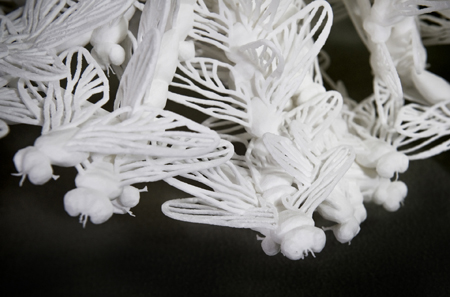







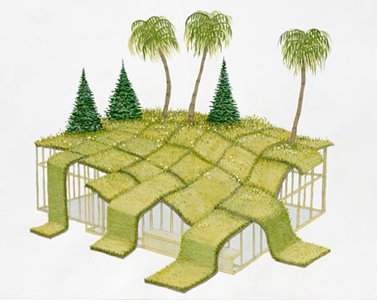


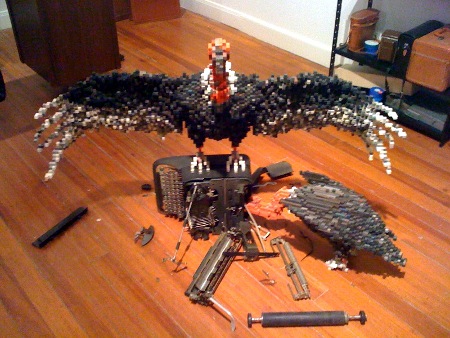


Posted: 18/04/2012 10:39 Updated: 18/04/2012 21:58
Disintegrating Eagle, by Shawn Smith
The brief lifespan of video games has been one of extraordinarily rapid advancement, particularly in terms of graphics.
If a comparison can be made to the art world then computer games have travelled from crude cave drawings, through the Renaissance, landing somewhere around Realism in a relative blink of an eye since they first appeared in the late 50s.
These wooden sculptures by artist Shawn Smith pay homage to a period in the mid 80s when computer graphics actually had more in common with a kind of Pointillism - if you were to use a square paint brush; the pixilated fires, monsters and animals gaming veterans will associate with early consoles like the ZX Spectrum or Commodore 64.
"Video games are an inspiration," Smith admits, "But so is the fact I really don't know much about the natural world."
"What I do know, I really only know through a screen. I grew up in Dallas, Texas. It is a big city without that many places to go camping. I have never seen a real campfire. I have never spent the night under the stars in a sleeping bag.
"These sculptures are about how much of the world is understood through some type of coded digital translation/re-translation rather than direct experience.
Albino Alligator, one of Smith's pixel sculptures
"What happens to an object or experience when information is lost, colours are distilled?"
40-year-old Smith holds a masters degree in sculpture from California College of the Arts in San Francisco, and has been widely exhibited around America. This year, his work will be shown as part of a large show at the Smithsonian American Art Museum's Renwick Gallery.
"I think the work has engaged people in and outside of the art world. I get very interesting responses from people who work in the technology, computers, video games. I think the subject matter has a universal appeal that a lot of people can relate to" he says.
After 7 years exhibiting in his own country, Smith now plans to try expand elsewhere.
"I am about to have my first solo show of this work in Europe. I am hoping to have more of a presence in Europe, Asia, the world!"
Perhaps, somewhere along the way, he'll get a chance to camp out under the stars.